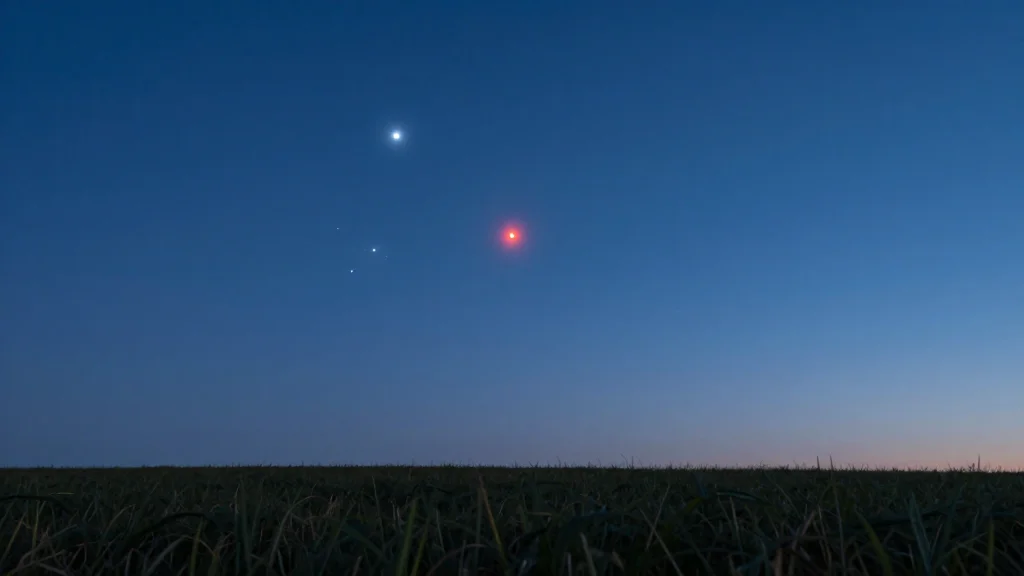
The Sky Today on Saturday, May 2: Venus Stands North of Aldebaran
Why It Matters
The alignment offers a prime visual for amateur astronomers and sky‑tourism operators, driving demand for binoculars, telescopes, and guided night‑sky events. Visibility of multiple bright objects in a single view boosts public engagement with astronomy and related retail sales.
Key Takeaways
- •Venus at magnitude –3.9 sits 6.5° north of Aldebaran
- •Uranus visible in Taurus at magnitude 5.8, 4.1° south of Alcyone
- •Moon is waning gibbous, 98% illuminated, rises at 9:25 PM
- •Sunset at 7:56 PM, sunrise at 5:59 AM for 40° N, 90° W
- •Venus appears 87% lit, 12″ across, ideal for telescopic viewing
Pulse Analysis
The May 2 night sky presents a textbook case of planetary conjunctions that attract both seasoned observers and newcomers. Venus, the brightest evening planet, reaches a striking –3.9 magnitude and aligns just north of Aldebaran, the orange‑hued anchor of Taurus. This proximity creates a natural guidepost for locating the Pleiades cluster and, with a little patience, the faint disk of Uranus at magnitude 5.8. For hobbyists, the event simplifies star‑hopping: a quick glance at the bright red star leads the eye to the planet, while a modest telescope or quality binoculars can reveal Uranus’s tiny 3‑arcsecond disk.
Beyond the pure visual appeal, the alignment fuels economic activity in the night‑sky market. Retailers see spikes in sales of optical gear, from entry‑level binoculars to mid‑range telescopes, as social media amplifies the event. Local astronomy clubs and tour operators capitalize on the timing, offering guided viewing sessions that bundle equipment rentals, educational talks, and refreshments. The clear, early‑fall weather typical of the 40° N, 90° W region further enhances attendance, translating celestial excitement into measurable revenue.
Long‑term, such high‑visibility events reinforce public interest in space science, supporting funding arguments for research and education initiatives. Media coverage and searchable content generate organic traffic for astronomy websites, improving SEO rankings and ad revenue. As the Moon waxes to a waning‑gibbous phase, its 98% illumination provides a bright backdrop without overwhelming the faint planets, making the night sky on May 2 an optimal blend of spectacle and accessibility for a broad audience.
The Sky Today on Saturday, May 2: Venus stands north of Aldebaran
Comments
Want to join the conversation?
Loading comments...