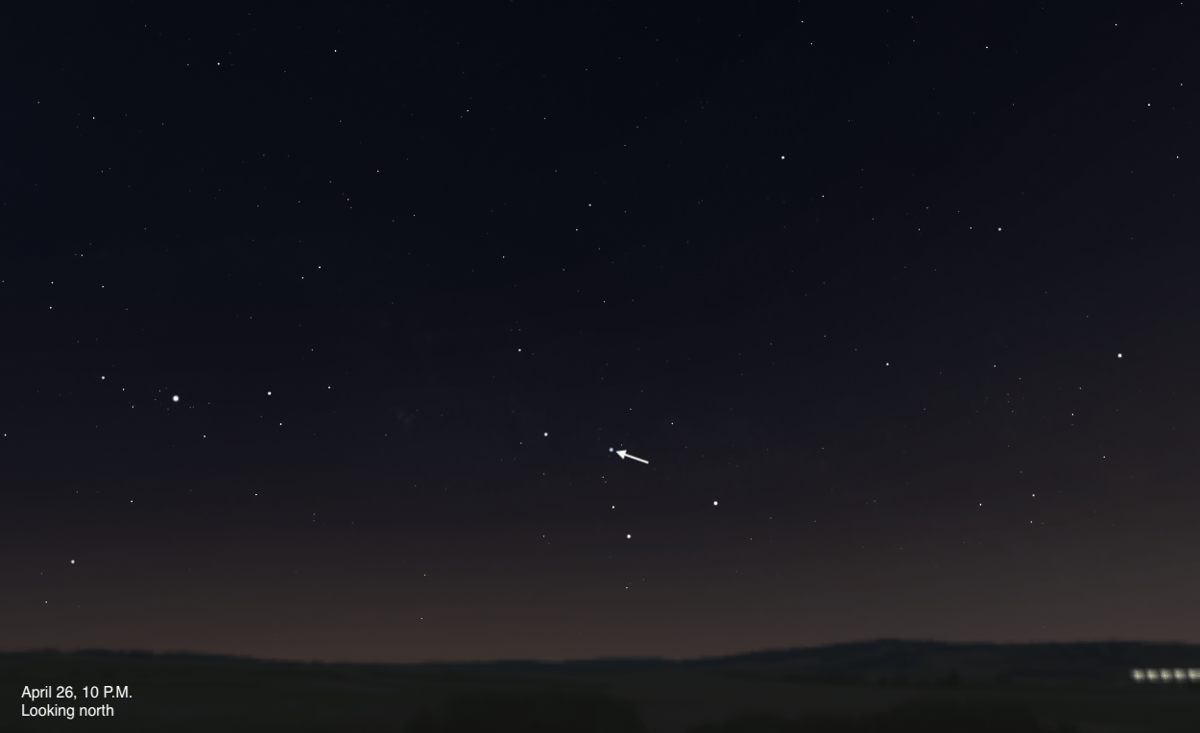
The Sky Today on Sunday, April 26: A Look at Enigmatic Gamma Cas
Why It Matters
Identifying the white dwarf as the X‑ray source resolves a decades‑old mystery about Be‑star emissions and refines models of binary star evolution. The finding impacts how astronomers interpret high‑energy phenomena in similar massive star systems.
Key Takeaways
- •Gamma Cas is a B‑type Be star 549 light‑years away
- •Its X‑rays are 40× stronger than similar-mass stars
- •New study identifies a magnetic white dwarf companion as X‑ray source
- •Material from the Be star’s disk accretes onto the white dwarf
- •Comet Tempel 2 will be visible near Aquila in early April 2026
Pulse Analysis
Gamma Cassiopeiae has served as the archetype for Be stars—rapidly rotating B‑type giants that eject material into a surrounding hydrogen disk. While its visual brilliance and spectral peculiarities have been well documented, the source of its anomalously strong X‑ray emission remained elusive, challenging conventional theories that link such high‑energy output to stellar winds alone. This mystery placed Gamma Cas at the forefront of high‑energy astrophysics, prompting extensive monitoring across multiple wavelengths.
The breakthrough came from a collaborative effort employing ultra‑precise photometry and spectroscopy, which pinpointed a faint, magnetic white dwarf orbiting the Be primary. As the Be star’s disk feeds gas onto the compact companion, an accretion disk forms around the white dwarf. Magnetic field lines funnel this material to the poles, where it is heated to millions of degrees, producing the observed X‑ray flux. This mechanism mirrors that of cataclysmic variables but occurs in a system dominated by a massive, rapidly rotating star, expanding the taxonomy of X‑ray binaries.
Beyond solving a specific astrophysical puzzle, the discovery reshapes our understanding of mass transfer and angular momentum loss in massive binaries. It suggests that other Be stars with unexplained X‑ray signatures may also harbor compact companions, prompting targeted searches with next‑generation X‑ray observatories. For amateur astronomers, the night sky offers a dual spectacle: Gamma Cas shines prominently in Cassiopeia, while comet Tempel 2 becomes visible near Aquila, providing a reminder that cutting‑edge research and sky‑watching often share the same celestial stage.
The Sky Today on Sunday, April 26: A look at enigmatic Gamma Cas
Comments
Want to join the conversation?
Loading comments...