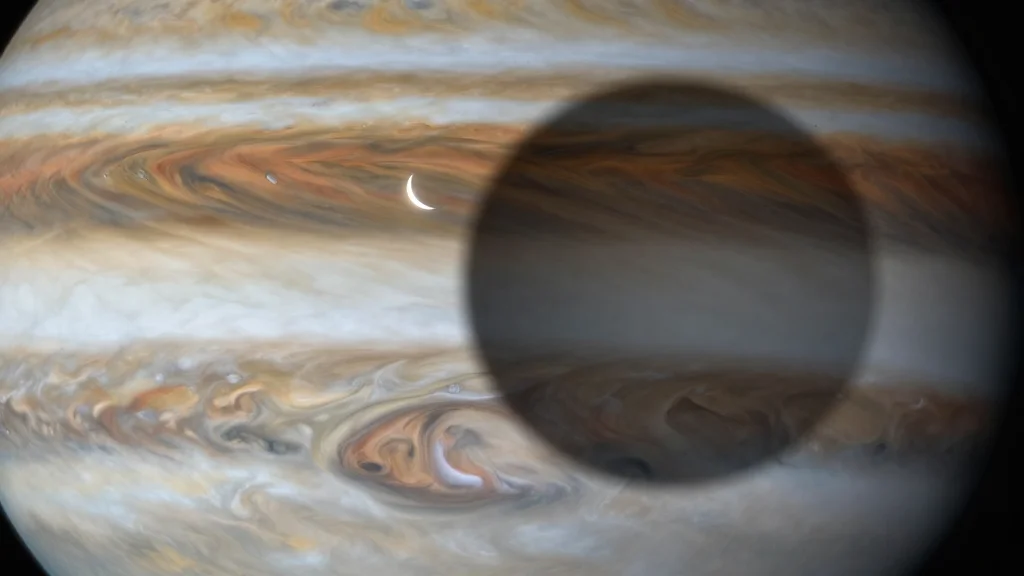
The Sky Today on Tuesday, April 14: An Io Transit
Why It Matters
The Io transit offers a rare, easily observable celestial alignment that engages amateur astronomers and highlights the dynamic nature of the Jovian system, reinforcing public interest in space science. Such events also drive demand for optical equipment and sky‑watching content, benefiting the astronomy market.
Key Takeaways
- •Io and shadow cross Jupiter from 11:25 PM to 1 AM EDT
- •Europa follows Io, appearing west of Jupiter after the transit
- •Mercury shines at magnitude 0.0 near the waning crescent Moon before sunrise
- •Astronomers recommend binoculars to spot Mercury and Mars low on the horizon
Pulse Analysis
The April 14‑15 Io transit provides a spectacular, hour‑long show for observers across North America. Beginning just after sunset, Io’s silhouette sweeps across Jupiter’s cloud bands, while its shadow follows a few minutes later, creating a dual‑track effect visible through modest telescopes or even high‑power binoculars. After the transit, Europa emerges west of the planet, offering a sequential glimpse of two of Jupiter’s largest moons in a single night. For sky‑watchers, the event is complemented by a low‑lying, magnitude 0.0 Mercury and a faint Mars, both rising just before the Sun, and a waning‑crescent Moon that adds a subtle glow to the pre‑dawn horizon.
Beyond visual appeal, Io transits are scientifically valuable. As Jupiter’s most volcanically active moon, Io’s passage across the planet allows precise timing measurements that refine orbital models and improve predictions of tidal interactions within the Jovian system. The shadow’s movement across Jupiter’s atmosphere can also be used to probe cloud dynamics and atmospheric composition, offering a low‑cost observational method for professional and citizen scientists alike. Such data contribute to broader studies of moon‑planet gravitational coupling, informing future missions to the outer planets.
The public’s fascination with this event translates into tangible market effects. Telescope manufacturers and retailers typically see a sales spike in the weeks surrounding high‑profile transits, as newcomers purchase entry‑level refractors and accessories. Streaming platforms and astronomy podcasts capitalize on the buzz, producing live‑commentary feeds that attract sponsorships and ad revenue. Moreover, educational institutions leverage the transit for outreach programs, reinforcing STEM engagement and potentially influencing future funding for space research. In sum, the Io transit not only enriches the night sky but also fuels economic activity across the astronomy ecosystem.
The Sky Today on Tuesday, April 14: An Io transit
Comments
Want to join the conversation?
Loading comments...