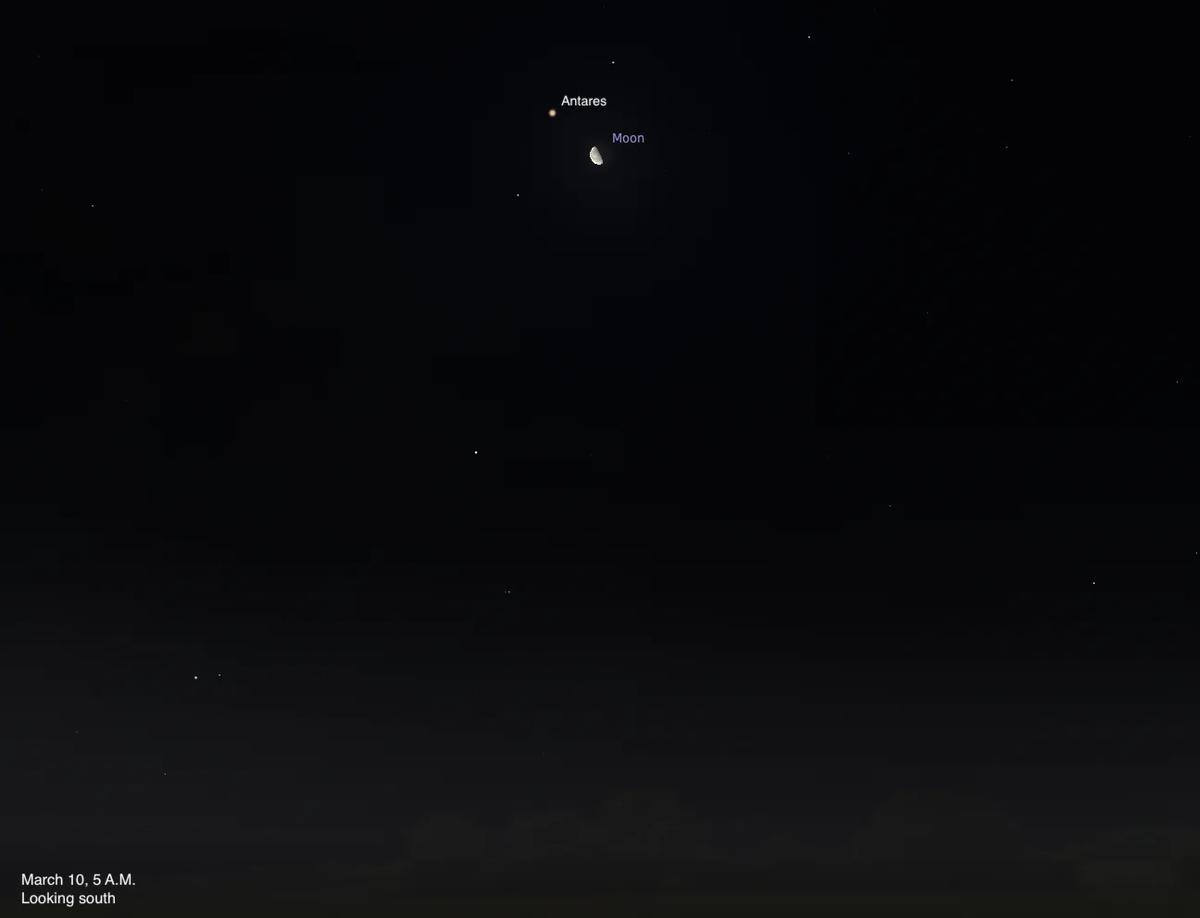
The Sky Today on Tuesday, March 10: The Moon Visits Red Giant Antares
•March 10, 2026
0
Why It Matters
The event provides a rare, low‑light opportunity for amateur astronomers to photograph a bright star beside the Moon, while the apogee timing highlights subtle changes in lunar size and brightness that affect observation planning.
Key Takeaways
- •Moon passes 0.7° south of Antares at 8 AM EDT
- •Antares appears orange/red through telescopes near the Moon
- •Lunar apogee occurs 9:43 AM EDT, 404,385 km away
- •Waning gibbous Moon at 53% illumination
- •Visible from mid‑latitudes, 20° above southern horizon
Pulse Analysis
The March 10 conjunction of the Moon and Antares offers more than a picturesque sky; it serves as a practical case study for timing celestial events. When the Moon skirts a bright star, the combined glare can challenge visual observers, yet it also creates a natural laboratory for testing exposure settings on cameras and telescopes. Understanding the precise angular separation—0.7° in this instance—helps photographers calculate optimal focal lengths and tracking rates, ensuring the red giant’s distinctive hue remains discernible against the lunar glare.
At 9:43 A.M. EDT the Moon reaches apogee, its most distant point from Earth, shrinking its apparent diameter by roughly 14 percent compared to perigee. This subtle reduction influences both visual perception and photometric measurements, making the Moon appear slightly dimmer and affecting shadow lengths during daytime observations. For skywatchers, the apogee coincides with the waning gibbous phase (53% illumination), providing a balanced light level that reduces atmospheric scattering while still offering sufficient brightness to locate the Moon without artificial aids.
Beyond the immediate visual appeal, the Moon‑Antares alignment underscores the value of coordinated public outreach. Astronomy clubs can leverage the event to teach concepts such as angular distance, stellar classification, and lunar orbital mechanics. Moreover, the timing aligns with sunrise and sunset windows that favor low‑light imaging, encouraging enthusiasts to experiment with long‑exposure techniques. By promoting these educational angles, the conjunction not only enriches hobbyist experiences but also reinforces broader public interest in stellar evolution and planetary science.
The Sky Today on Tuesday, March 10: The Moon visits red giant Antares
0
Comments
Want to join the conversation?
Loading comments...