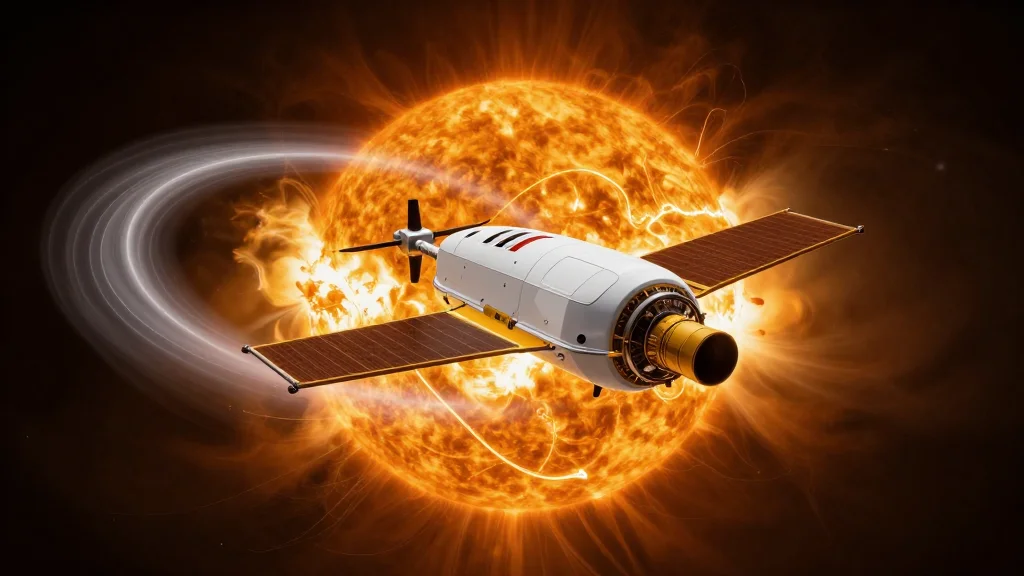
The Solar Wind's Secret Hammerheads and What They Tell Us About Heat in Space
Companies Mentioned
Why It Matters
By linking hammerhead proton events to the HCS, the study provides a tangible mechanism for solar‑wind heating and a new observational tool for monitoring magnetic structures that affect space‑weather conditions.
Key Takeaways
- •173,000 hammerhead proton events identified from 3.7 million measurements
- •Hammerheads concentrate near the heliospheric current sheet, mapping its geometry
- •These non‑thermal proton beams store energy that can heat the solar wind
- •Hammerhead signatures also appear near coronal mass ejections and magnetic switchbacks
- •Automated detection now offers a new tool for forecasting solar‑wind conditions
Pulse Analysis
The Parker Solar Probe’s unprecedented proximity to the Sun has revealed a subtle yet powerful feature in the solar wind: hammerhead‑shaped proton velocity distributions. By scanning 20 close‑approach orbits, scientists developed an algorithm that sifted through 3.7 million proton measurements and isolated roughly 173 000 hammerhead events. These structures appear as elongated “heads” jutting from the bulk plasma, a visual cue that was first likened to a shark’s silhouette during a routine data‑calibration session in 2020. Their prevalence near the heliospheric current sheet—a vast, rippling magnetic boundary where the Sun’s field flips polarity—provides a direct, data‑driven map of the HCS’s shape and movement throughout the solar cycle.
Beyond serving as a tracer, hammerheads are energetic reservoirs. The anisotropic proton beams carry free energy that can cascade into electromagnetic waves and ultimately heat the surrounding plasma. This mechanism addresses a long‑standing puzzle: the solar wind does not cool as rapidly as classical expansion theory predicts. By linking the extra heating to current‑sheet‑related particle acceleration, the findings suggest that magnetic reconnection and wave‑particle interactions at the HCS are significant contributors to the wind’s temperature profile, a process that mirrors similar phenomena observed in Earth’s magnetotail.
The practical payoff is equally compelling. An automated detection pipeline now enables real‑time monitoring of hammerhead occurrences, offering a novel forecasting metric for space‑weather models. Because these events also cluster around coronal mass ejections and magnetic switchbacks, they could serve as early indicators of turbulent solar‑wind structures that impact satellite operations and power grids on Earth. As the Sun ramps up toward solar maximum, tracking hammerheads may become a cornerstone of predictive heliophysics, bridging fundamental plasma science with operational forecasting needs.
The solar wind's secret hammerheads and what they tell us about heat in space
Comments
Want to join the conversation?
Loading comments...