Companies Mentioned

Why It Matters
These flares demonstrate that space‑weather threats to satellite communications, GPS and power grids persist beyond the solar maximum, prompting ongoing vigilance from operators and policymakers.
Key Takeaways
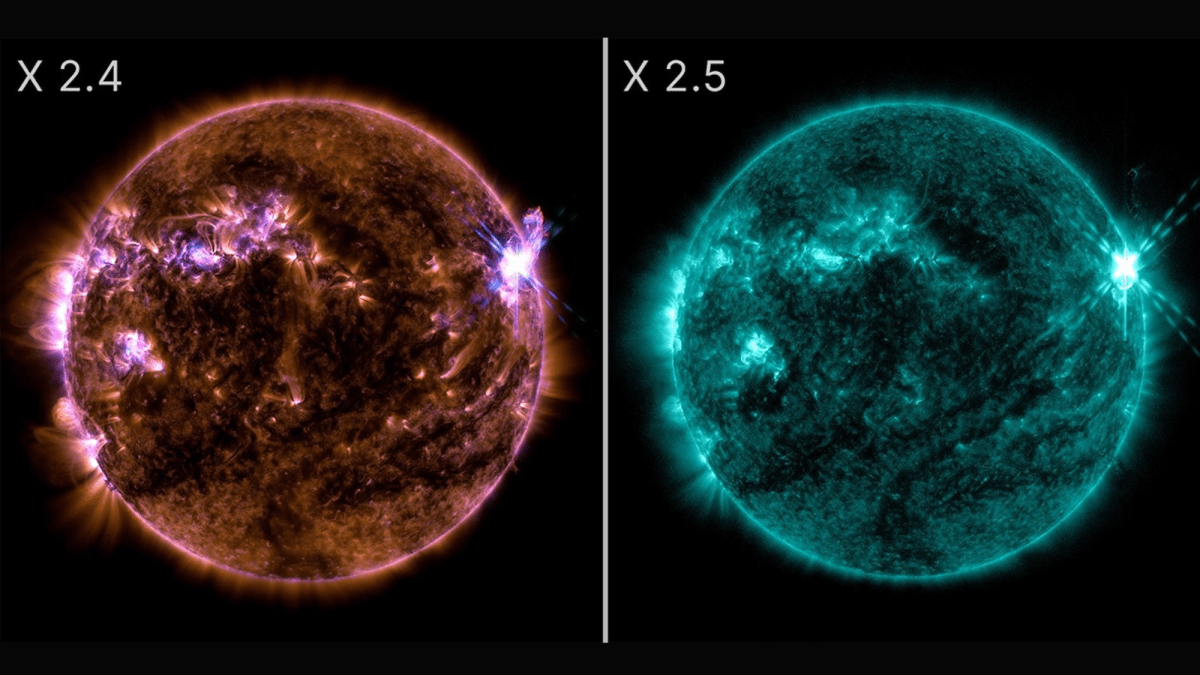
- •NASA recorded X2.4 flare at 9:07 p.m. EDT, April 23.
- •Follow-up X2.5 flare erupted at 4:13 a.m. EDT, April 24.
- •Both flares triggered brief radio blackouts over Pacific, Australia, East Asia.
- •Flares occurred after solar maximum, showing lingering high activity.
- •Historical comparison: 2003 X40 flare far stronger than current events.
Pulse Analysis
Solar flares are classified from A to X, each step representing roughly a tenfold increase in energy. The recent X2.4 and X2.5 events sit near the lower end of the X‑class spectrum, yet they are still capable of disrupting high‑frequency radio paths and ionospheric conditions. NASA’s Solar Dynamics Observatory captured the eruptions in unprecedented detail, providing scientists with real‑time data on plasma temperatures, magnetic reconnection sites, and associated coronal mass ejections. This information feeds directly into space‑weather forecasting models that protect critical infrastructure.
When a flare’s emissions are Earth‑directed, the planet’s magnetosphere can experience sudden disturbances. Even modest X‑class bursts can induce short‑lived radio blackouts, degrade GPS accuracy, and trigger auroral displays at lower latitudes. Operators of satellite constellations, aviation communication networks, and energy utilities monitor alerts from NOAA’s Space Weather Prediction Center to implement mitigation steps, such as re‑routing traffic or placing sensitive equipment in safe modes. The April 2026 flares, while not catastrophic, served as a reminder that the space environment remains a dynamic risk factor for modern digital economies.
Looking ahead, Solar Cycle 25 is projected to peak around 2025‑2026, with activity gradually tapering but never fully ceasing. Continuous observation from missions like SDO, the Parker Solar Probe, and upcoming ESA solar observatories will sharpen predictive capabilities. Industries ranging from telecom to autonomous vehicles are investing in hardened hardware and adaptive software to withstand solar‑induced anomalies. As the Sun’s magnetic rhythm evolves, proactive space‑weather resilience will become a core component of operational risk management.
The sun just fired off two massive solar flares
Comments
Want to join the conversation?
Loading comments...