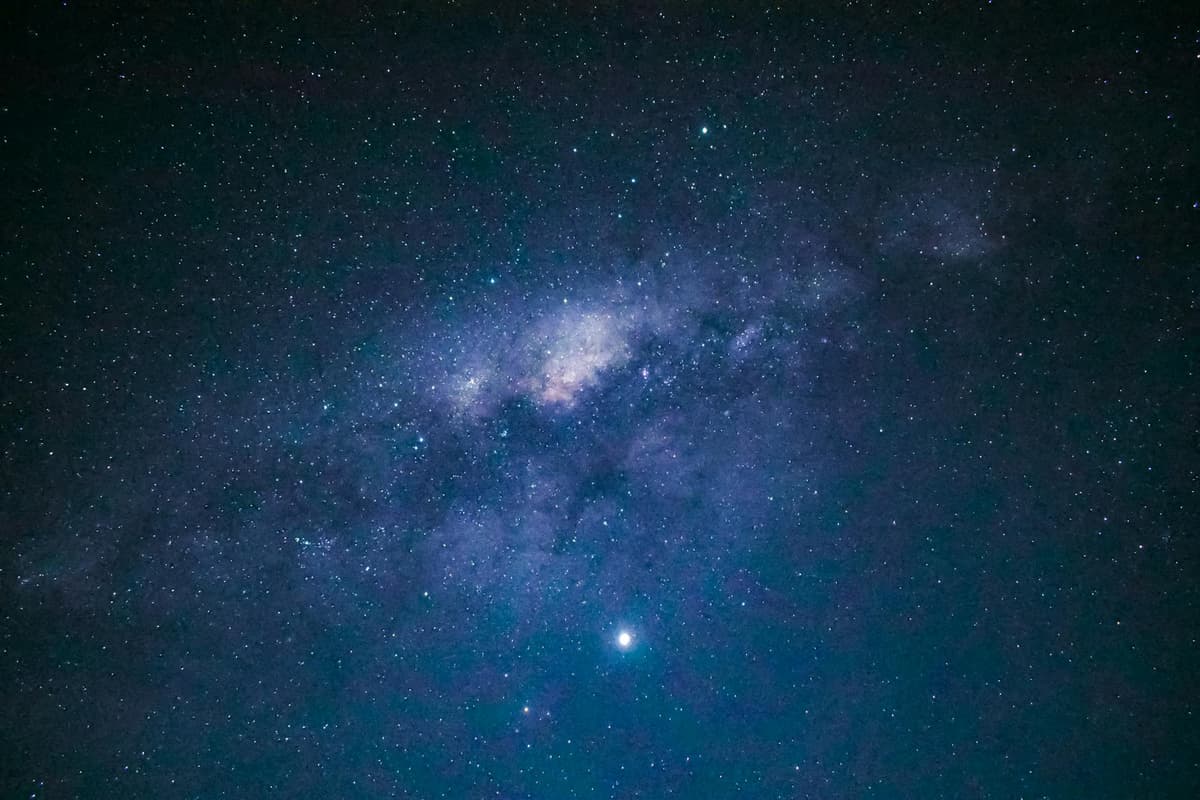
The Supermassive Black Hole at the Centre of the Milky Way Has a Mass of 4 Million Suns, and the Entire Solar System Is Orbiting It at 514,000 Mph without Anyone on Earth Feeling a Thing
Why It Matters
Understanding these numbers clarifies common misconceptions about cosmic motion and highlights how inertial frames and dark‑matter‑dominated dynamics shape our galaxy’s behavior.
Key Takeaways
- •Sagittarius A* weighs ~4.1 million solar masses, inferred from stellar orbits.
- •Solar system circles the galactic center at ~514,000 mph (230 km/s).
- •Resulting centripetal acceleration is ~2 × 10⁻¹⁰ m/s², imperceptible to humans.
- •Milky Way’s total mass (~1‑1.5 trillion suns) dwarfs the black hole’s share.
- •Uniform motion cannot be sensed; only changes in acceleration are felt.
Pulse Analysis
Sagittarius A*, the radio source at the Milky Way’s core, earned its mass estimate long before the Event Horizon Telescope captured its shadow in 2022. Astronomers tracked stars such as S2, whose rapid, elliptical paths around an invisible focus revealed a gravitational pull equivalent to about 4.1 million solar masses. This calculation, while precise, carries uncertainties and assumes a single supermassive black hole rather than alternative dense dark‑matter configurations, underscoring the model‑dependent nature of astrophysical measurements.
The Sun and its planetary family travel around the galactic center at roughly 230 km/s, a speed that translates to about 514,000 mph. Over a galactic year—approximately a quarter‑billion Earth years—the solar system traces a slightly wobbling, non‑circular path influenced by spiral arms and massive molecular clouds. Despite the high velocity, the centripetal acceleration is minuscule, about 2 × 10⁻¹⁰ m/s², far below the threshold of human sensation. This illustrates Galileo’s principle of relativity: uniform motion is undetectable from within the moving frame, a concept later formalized by Einstein.
The broader significance lies in how the central black hole fits into the galaxy’s mass budget. With the Milky Way’s total mass estimated at 1‑1.5 trillion solar masses, Sagittarius A* accounts for only 0.0003 percent, meaning the Sun’s orbit is governed primarily by the combined gravity of stars, gas, and dark matter. Clarifying these dynamics helps dispel sensationalist headlines and provides educators with concrete examples of inertial frames, dark‑matter dominance, and the scale‑dependent nature of gravitational forces—key topics for anyone following modern astrophysics.
The supermassive black hole at the centre of the Milky Way has a mass of 4 million suns, and the entire solar system is orbiting it at 514,000 mph without anyone on Earth feeling a thing
Comments
Want to join the conversation?
Loading comments...