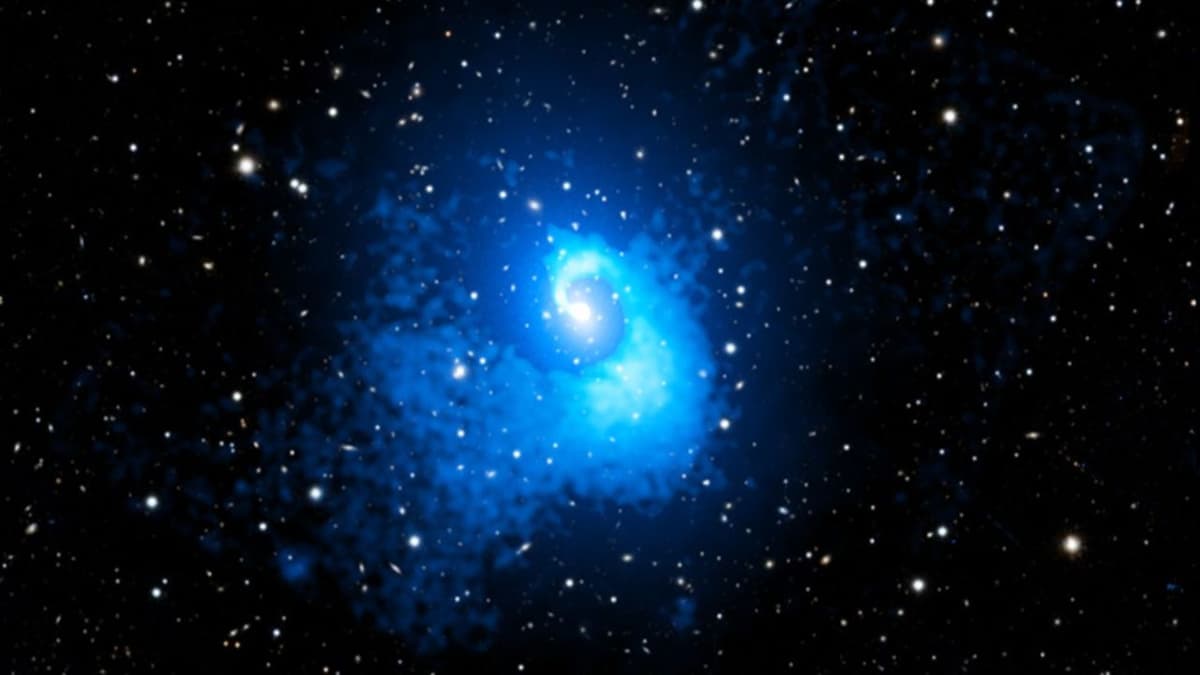
The Universe's 'Most Relaxed' Galaxy Cluster Was Shaped by Cosmic Violence, New Study Finds
Why It Matters
Understanding how mergers stir and heat intracluster gas refines models of galaxy‑cluster evolution and the balance between cooling and AGN feedback, impacting cosmological simulations and mass‑estimation techniques.
Key Takeaways
- •Chandra finds 2‑million‑light‑year sloshing spiral in Abell 2029.
- •Collision 4 billion years ago left shock fronts, bay, and splash.
- •Sloshing motions may supplement black‑hole feedback in heating gas.
- •Study challenges notion of Abell 2029 as perfectly relaxed cluster.
Pulse Analysis
Galaxy clusters are the largest gravitationally bound structures in the universe, and their hot intracluster medium radiates X‑rays that should cause the gas to cool and condense over billions of years. Yet observations repeatedly show a puzzling temperature floor, implying that some heating mechanism offsets radiative losses. Historically, feedback from active supermassive black holes—AGN feedback—has been the leading explanation, but recent work suggests additional processes may be at play, especially in clusters once deemed dynamically quiet.
The latest Chandra study of Abell 2029 overturns that quiet reputation. By stacking 21 new X‑ray observations with archival data, astronomers uncovered a sprawling 2‑million‑light‑year sloshing spiral, a concave “bay,” a cooler “splash,” and hints of a shock wave—signatures of a violent merger roughly 4 billion years ago. Simulations indicate a smaller sub‑cluster pierced the core, displacing the hot gas and setting it into long‑lasting oscillations that resemble wine swirling in a glass. These motions redistribute heat across the cluster, working in tandem with energy injected by the central black hole in the massive galaxy IC 1101.
The discovery reshapes how researchers model cluster thermodynamics. Incorporating merger‑driven sloshing into cosmological simulations could improve predictions of X‑ray luminosity, mass estimates, and the evolution of the cooling‑flow problem. Moreover, the findings motivate deeper multi‑wavelength campaigns—combining X‑ray, radio, and optical data—to hunt for similar substructures in other “relaxed” clusters. As the next generation of observatories like Athena and Lynx come online, the nuanced interplay between ancient collisions and black‑hole activity will become a key frontier in understanding the lifecycle of the universe’s most massive structures.
The universe's 'most relaxed' galaxy cluster was shaped by cosmic violence, new study finds
Comments
Want to join the conversation?
Loading comments...