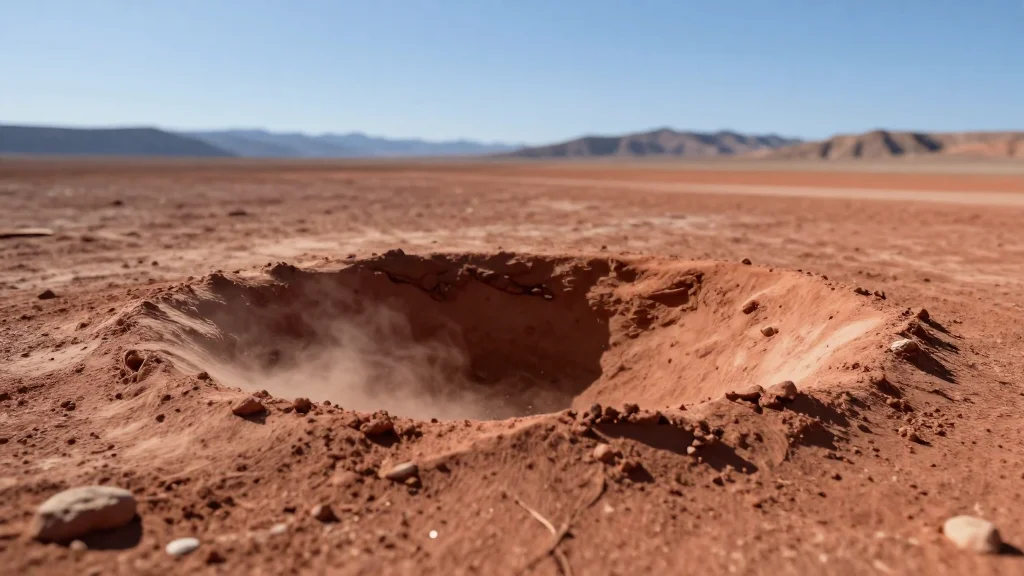
The Zhamanshin Impact Event Was Likely Much More Destructive than Thought
Why It Matters
A doubled crater size dramatically raises the event’s energy and potential climate impact, reshaping how scientists assess the role of impacts in Earth’s geological and biological evolution. It also provides a methodological template for revisiting other poorly preserved impact structures.
Key Takeaways
- •Zhamanshin crater diameter revised to ~26.5 km, double previous estimate
- •Impact energy estimated over 240,000 Mt TNT, ~7‑10× prior calculations
- •Potential climate disruption during Mid‑Pleistocene Transition may link to impact
- •LiDAR and multi‑DEM analysis revealed hidden outer crater rings
- •Findings could reshape impact assessments on Earth and Mars
Pulse Analysis
The latest pre‑print from NASA’s Goddard Space Flight Center leverages LiDAR‑derived topography and five distinct digital elevation models to map the Zhamanshin structure’s concealed outer rings. By quantifying subtle elevation changes around the visible basin, the team identified a multi‑ringed complex extending to roughly 26.5 km—far larger than the long‑standing 14 km figure. This methodological breakthrough underscores how advanced remote‑sensing can overcome erosion and loess cover that have traditionally obscured ancient impact signatures.
A crater of this magnitude translates to kinetic energy surpassing 240,000 megaton TNT, dwarfing the combined yield of the two WWII atomic bombs by several orders of magnitude. Such an explosion would have injected massive aerosols and dust into the atmosphere, potentially inducing a short‑term “impact winter.” While the Mid‑Pleistocene Transition already featured dramatic glacial reorganizations, the revised impact scenario offers a plausible external driver for abrupt climate shifts and associated biotic stress, inviting renewed scrutiny of pollen, spore and marine microfossil records from the 900,000‑year window.
Beyond Earth, the study’s implications ripple to planetary protection and astrobiology. If multi‑ringed complexes can be systematically missed on terrestrial terrains, analogous structures on Mars or the Moon may also be under‑recognized, affecting hazard assessments for future crewed missions. The research therefore not only refines our understanding of a single event but also establishes a scalable framework for re‑evaluating the recent impact record across the solar system, aligning with NASA’s Moon‑to‑Mars exploration priorities.
The Zhamanshin impact event was likely much more destructive than thought
Comments
Want to join the conversation?
Loading comments...