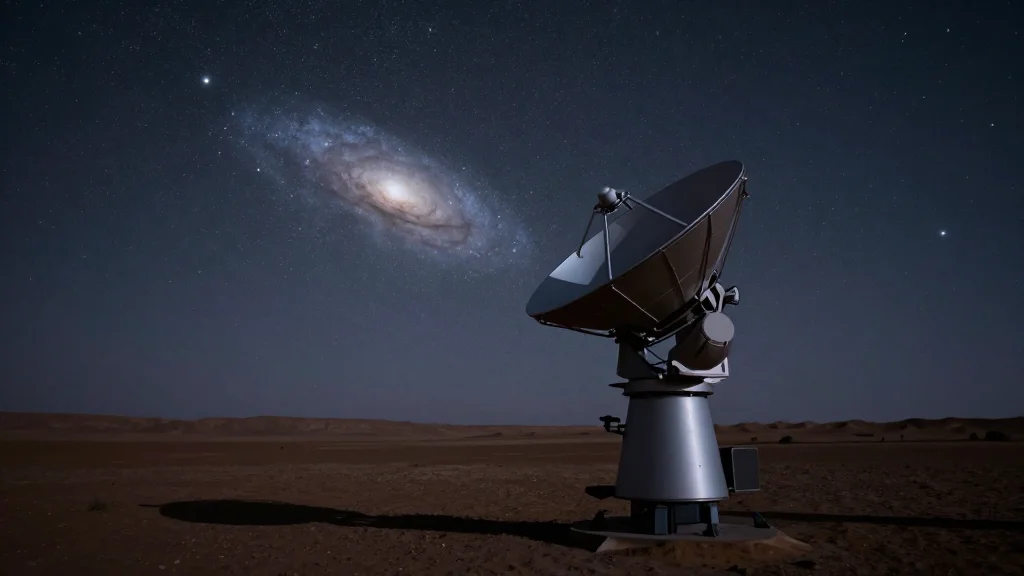
Third Time’s the Charm for a Row of Faint Galaxies Without Dark Matter
Why It Matters
The existence of dark‑matter‑free galaxies challenges the prevailing ΛCDM paradigm and forces theorists to reconsider galaxy formation mechanisms, potentially reshaping dark‑matter research.
Key Takeaways
- •Third dark-matter‑deficient galaxy confirmed in same group
- •Stellar velocities indicate mass matches visible matter only
- •Findings pressure ΛCDM to explain baryon‑only galaxies
- •Potential tidal stripping or formation anomalies suggested
- •Observations used Hubble and Keck spectroscopy
Pulse Analysis
Dark matter remains one of the most elusive components of the cosmos, inferred from galaxy rotation curves, gravitational lensing, and large‑scale structure. For decades, the ΛCDM model has assumed that every galaxy sits within a massive dark‑matter halo that dominates its gravitational potential. Yet the 2018 discovery of the ultra‑diffuse galaxy NGC 1052‑DF2, followed by DF4, revealed systems where stellar motions suggested a total mass comparable to the visible stars alone. These outliers sparked intense debate, prompting astronomers to search for additional examples that could either confirm a new class of objects or expose measurement errors.
The latest study, announced in June 2026, reports a third such galaxy—designated NGC 1052‑DFX—located in the same loose group as DF2 and DF4. High‑resolution imaging from the Hubble Space Telescope identified its diffuse morphology, while Keck spectroscopy measured a remarkably low velocity dispersion of just 8 km s⁻¹. This translates to a dynamical mass of roughly 2 × 10⁸ M☉, essentially matching the stellar mass derived from its luminosity. The consistency across three independent systems strengthens the case that dark‑matter‑deficient galaxies are real, not artifacts.
The implications ripple through both observational and theoretical astrophysics. If galaxies can assemble without dark halos, models of hierarchical clustering and feedback must accommodate alternative pathways, such as tidal stripping during close encounters or formation in regions of unusually low dark‑matter density. Moreover, these objects provide a natural laboratory for testing modified‑gravity theories that seek to explain cosmic dynamics without unseen mass. Ongoing surveys with the Vera C. Rubin Observatory and upcoming James Webb Space Telescope observations are expected to uncover more candidates, potentially redefining our understanding of the dark sector.
Third Time’s the Charm for a Row of Faint Galaxies Without Dark Matter
Comments
Want to join the conversation?
Loading comments...