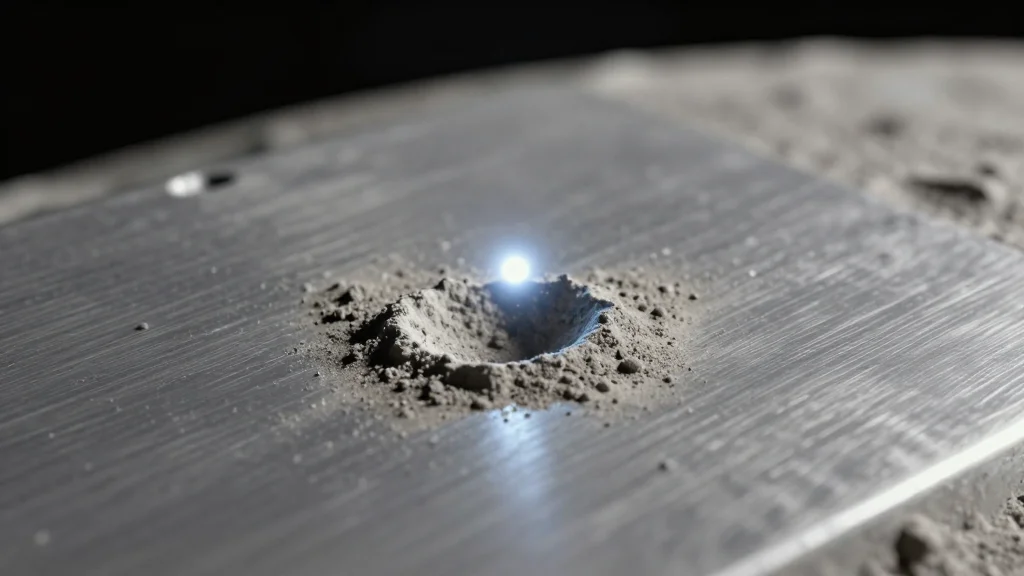
This AI Prediction Model Could Help Shield Future Lunar Habitats Against Micrometeorites
Why It Matters
Accurate, fast predictions of micrometeorite damage are essential to design lightweight, safe lunar habitats, directly affecting the cost and timeline of NASA’s 2030 Moon base program.
Key Takeaways
- •Artemis II recorded six micrometeorite flashes in 30 minutes.
- •AI model predicts penetration depth for 1‑3 mm meteoroids up to 70 km/s.
- •$15 M NASA grant funds ANN to replace expensive impact testing.
- •Tool enables early trade‑off studies for lightweight, in‑situ lunar shielding.
Pulse Analysis
The Artemis II crew’s brief lunar flyby revealed a surprisingly high rate of micrometeorite activity—six bright impact flashes were logged in just half an hour. These flashes, captured by the astronauts and now being cross‑checked with Lunar Reconnaissance Orbiter imagery, suggest that the near‑side lunar environment is more dynamic than many models have assumed. For a habitat that will sit on the Moon’s surface, each high‑velocity particle, even one only a few millimetres across, carries enough kinetic energy to puncture thin shielding and jeopardize crew safety. Understanding the true flux and energy distribution of these impacts is therefore a prerequisite for any sustainable lunar settlement.
To turn those observations into actionable design data, a team from the University of Texas at San Antonio and Purdue University has built a deep‑learning artificial neural network trained on simulated impacts of 1‑ to 3‑mm particles traveling up to 70 km s⁻¹. Funded by a $15 million NASA grant, the ANN can estimate penetration depth for a wide range of regolith‑aluminium shielding configurations without running time‑consuming finite‑element analyses. Early tests show the model matches—or exceeds—the accuracy of traditional methods while delivering results in seconds, giving engineers a rapid trade‑off tool for material selection and thickness optimization.
The ability to predict micrometeorite damage early in the design cycle could shave millions off the cost of lunar infrastructure by reducing the need for heavyweight, over‑engineered shielding and extensive ground‑based testing. It also dovetails with NASA’s push for in‑situ resource utilization, where regolith‑based 3‑D‑printed walls can be paired with thin aluminium skins whose performance is now quantifiable. Nevertheless, the model’s accuracy still hinges on expanding the empirical dataset—particularly at the upper velocity envelope—so future Artemis missions and lunar orbiters will be critical for validation. If refined, the ANN could become a standard component of lunar habitat engineering toolkits.
This AI prediction model could help shield future lunar habitats against micrometeorites
Comments
Want to join the conversation?
Loading comments...