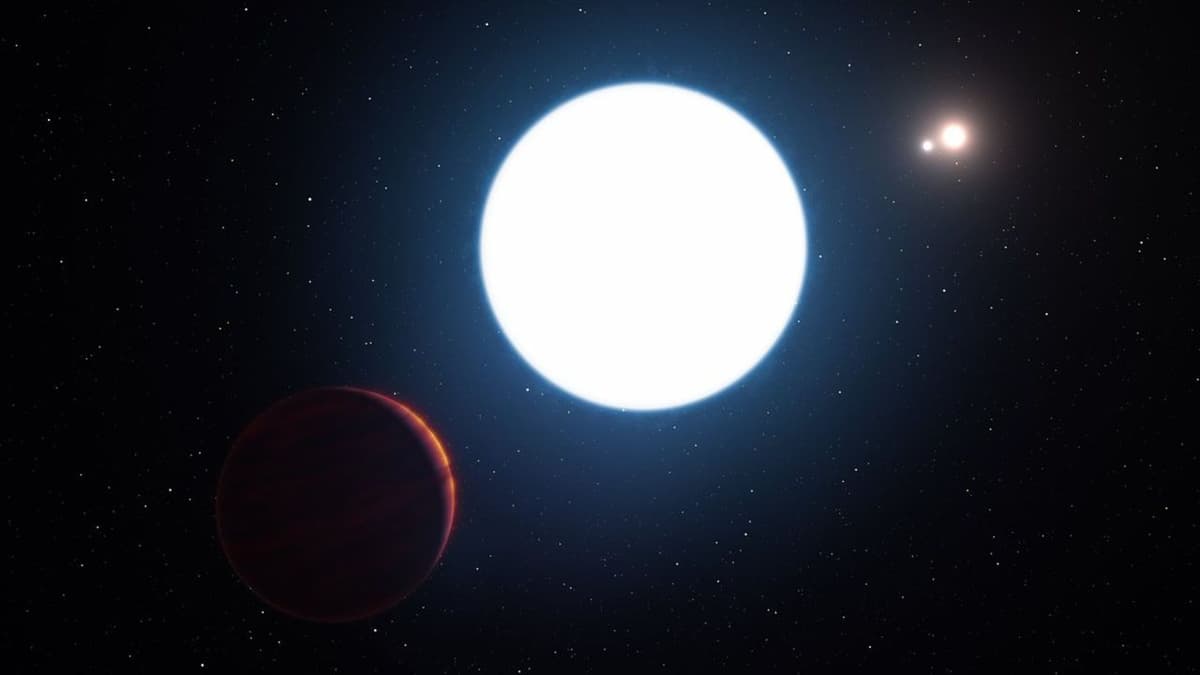
This Star System Creates a Rare Triple Eclipse. Here's What that Would Look Like
Why It Matters
The coplanar triple offers a rare laboratory for testing theories of multi‑star formation and stellar evolution, while its dynamics illustrate the severe constraints on planet habitability in complex systems.
Key Takeaways
- •TIC 295741342 is a coplanar triple star 3,080 ly away
- •All three stars eclipse each other, creating a distinctive “head‑and‑shoulders” light curve
- •Coplanarity suggests formation via disk fragmentation rather than capture
- •The system’s dynamics limit stable planetary orbits, especially around the inner binary
- •The aging outer star may trigger a common‑envelope phase, merging the binary
Pulse Analysis
Triple‑star systems are common, but finding one where all three bodies line up edge‑on to Earth is exceptionally rare. TIC 295741342’s perfectly coplanar configuration was uncovered by TESS while it was scanning for exoplanet transits, and the resulting light curve resembles a head‑and‑shoulders silhouette. This geometry provides astronomers with a clean view of mutual eclipses, allowing precise measurements of stellar masses, radii, and orbital mechanics. Moreover, the system validates disk‑fragmentation models, which predict that a rotating protostellar disk can split into multiple cores that remain in the same orbital plane.
The arrangement has profound implications for any potential planets. The inner binary creates an inner exclusion zone where planetary orbits would be destabilized, while the distant third star further restricts stable zones beyond the binary’s influence. Consequently, any planets would need to orbit the outer star at great distances, making detection challenging. This dynamic mirrors the broader challenge of finding habitable worlds in multi‑star environments, where gravitational perturbations can strip away or prevent the formation of stable, life‑supporting orbits.
Looking ahead, the system also serves as a preview of stellar death throes. The outer star has already left the main sequence and expanded to over ten times the Sun’s diameter. As it continues to swell, its outer layers may be siphoned by the inner binary, forming a common‑envelope that could destabilize the binary’s orbit and lead to a merger. Such interactions are key to understanding how close binaries evolve into exotic objects like blue stragglers or Type Ia supernova progenitors, making TIC 295741342 a valuable touchstone for future theoretical and observational work.
This star system creates a rare triple eclipse. Here's what that would look like
Comments
Want to join the conversation?
Loading comments...