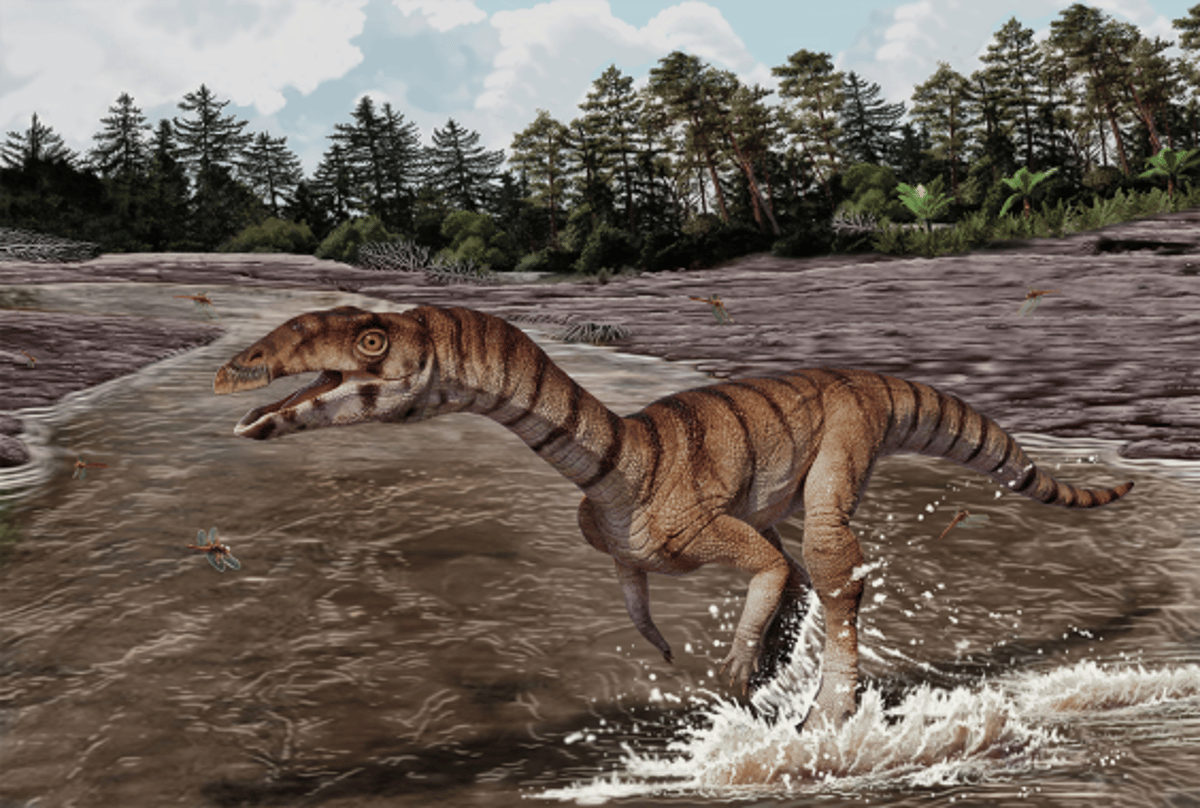
This Toothless, Beaked Crocodile Ancestor Walked on Two Legs
Why It Matters
The discovery clarifies how bipedal locomotion evolved independently in archosaurs and refines the crocodile‑bird evolutionary tree, aiding paleobiologists in reconstructing Triassic ecosystems.
Key Takeaways
- •New species Labrujasuchus expectatus described from Triassic deposits
- •Toothless, beaked skull indicates specialized feeding strategy
- •Bipedal posture parallels bird‑like dinosaurs of same era
- •Fifth shuvosaurid species bridges gap between older and newer forms
- •Highlights convergent evolution of bipedalism in archosaurs
Pulse Analysis
The early Triassic was a period of rapid ecological turnover, as the planet recovered from the Permian‑end mass extinction. In that vacuum, archosaurs diversified into a bewildering array of forms, from armored herbivores to predatory giants. Labrujasuchus expectatus adds a striking new chapter to this story: a crocodile‑lineage animal that shed teeth, grew a beak, and adopted a two‑legged gait. Its fossils, unearthed in North America and described in the Journal of Vertebrate Paleontology, provide a rare glimpse of how early archosaurs experimented with body plans that would later dominate the Mesozoic sky and land.
What makes L. expectatus especially intriguing is its convergence with contemporaneous bird‑like dinosaurs. While true dinosaurs were already perfecting bipedal locomotion, this shuvosaurid independently evolved a similar upright stance, suggesting that the mechanical advantages of bipedalism—speed, agility, and a free forelimb for feeding or display—were broadly advantageous across archosaur clades. The beaked, toothless skull hints at a niche shift toward selective herbivory or omnivory, echoing the dietary adaptations seen in later ornithischian dinosaurs and modern birds. Such parallel evolution underscores the plasticity of archosaur anatomy under similar selective pressures.
Beyond its novelty, Labrujasuchus expectatus refines the phylogenetic framework linking crocodiles and birds. By occupying a chronological middle ground between earlier shuvosaurids and their more derived relatives, it helps calibrate divergence dates and clarifies trait evolution within the group. Researchers can now test hypotheses about the timing of bipedalism, beak development, and tooth loss across archosaurs. As more specimens emerge, this lineage may reveal how early experiments in form set the stage for the dominant reptilian architectures that defined the Jurassic and Cretaceous periods, offering a richer narrative of life's resilience after mass extinction.
This Toothless, Beaked Crocodile Ancestor Walked on Two Legs
Comments
Want to join the conversation?
Loading comments...