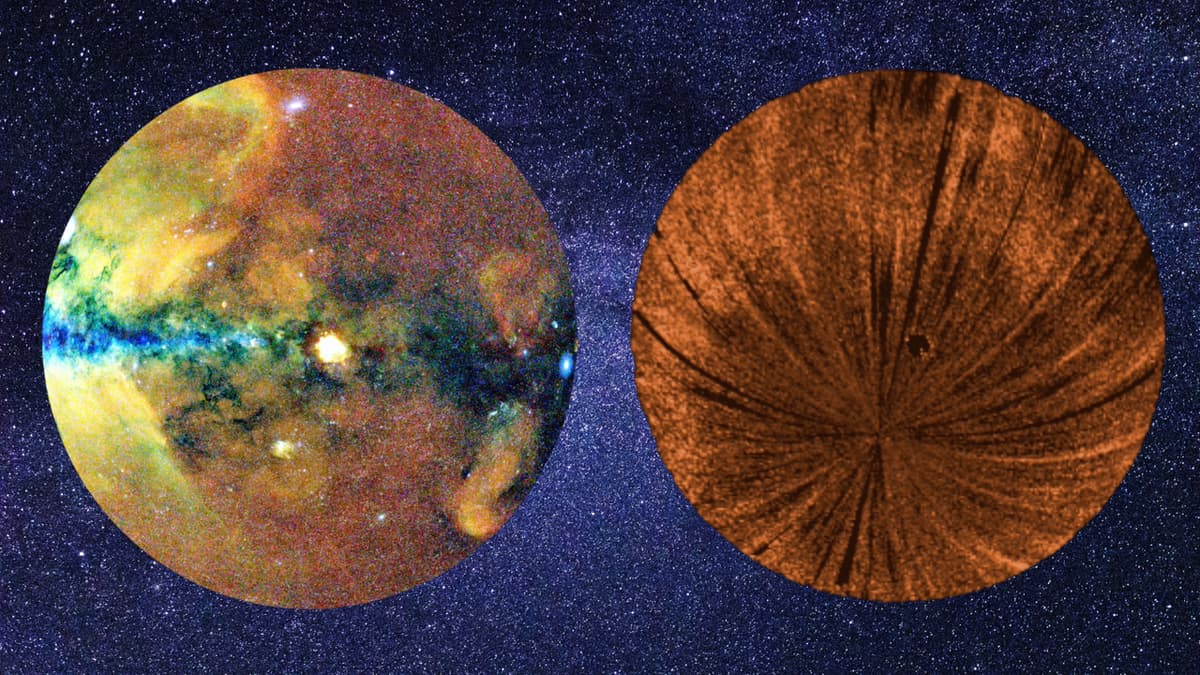
This X-Ray Image Shows Our Solar System 'Breathing'
Why It Matters
By converting a source of interference into a diagnostic, the study enhances our ability to separate foreground X‑ray emission from true cosmic signals, improving models of the Milky Way’s plasma environment and space‑weather forecasting.
Key Takeaways
- •eROSITA mapped soft X‑ray sky, revealing solar wind charge exchange
- •Solar wind charge exchange intensity follows the 11‑year solar cycle
- •Background X‑ray noise now serves as a diagnostic tool for heliophysics
- •Observations were made from L2, 932,000 mi (1.5 million km) away
- •Improved X‑ray maps aid accurate study of the Milky Way’s warm plasma
Pulse Analysis
The eROSITA telescope, launched by Roscosmos in 2019 and stationed at the gravitationally stable Lagrange Point 2, was designed to chart the X‑ray universe. While its primary goal was to probe distant galaxy clusters, the instrument’s sensitivity to soft X‑rays also captured a pervasive glow originating much closer to home. By repeatedly scanning the entire sky over two years, eROSITA generated a high‑resolution map that distinguishes faint cosmic X‑ray sources from foreground emissions, a long‑standing challenge for astronomers.
At the heart of the foreground glow is solar wind charge exchange, a process where high‑energy ions from the Sun steal electrons from neutral atoms in Earth’s upper atmosphere or the heliosphere, emitting soft X‑rays in the process. The new map shows that SWCX intensity waxes and wanes in step with the Sun’s 11‑year activity cycle, offering a real‑time proxy for solar wind conditions. This insight transforms what was once considered background noise into a valuable diagnostic for heliophysics, aiding space‑weather models that predict geomagnetic storms and their impact on satellite operations.
Separating SWCX from genuine cosmic X‑ray signals refines measurements of the Milky Way’s circumgalactic medium—a hot, diffuse plasma that influences galaxy evolution. With a cleaner view of the X‑ray sky, researchers can more accurately assess the temperature and density of distant plasma clouds, improving cosmological simulations. The breakthrough also sets a precedent for future missions, such as ESA’s Athena, to incorporate foreground correction strategies from the outset, ensuring that the next generation of X‑ray observatories can unlock deeper insights into the universe’s structure.
This X-ray image shows our solar system 'breathing'
Comments
Want to join the conversation?
Loading comments...