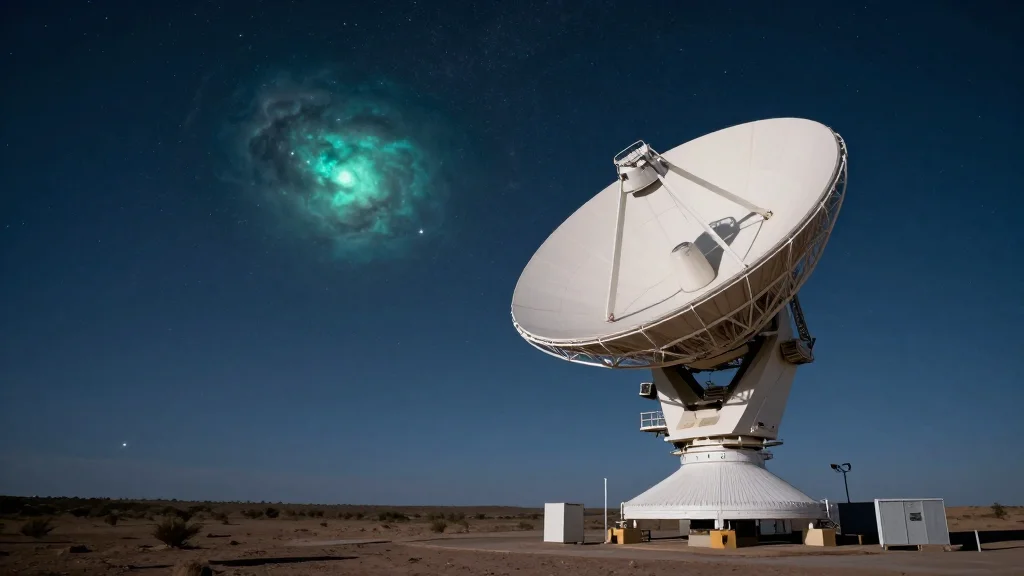
TIME Instrument Unlocks Faint Signals From Early Galaxies Across Vast Stretches of Sky
Why It Matters
By aggregating faint signals from countless early galaxies, TIME provides a scalable method to chart cosmic structure when individual objects are undetectable, accelerating research on the universe’s formative epochs.
Key Takeaways
- •TIME uses line‑intensity mapping to capture combined light from millions of galaxies.
- •First commissioning on Sagittarius A validates spectrometer’s frequency resolution.
- •Technique will enable studies of epoch‑of‑reionization via ionized carbon.
- •Upcoming observations target the COSMOS field for high‑redshift galaxies.
- •Line‑intensity mapping gains traction, influencing future submillimeter telescopes.
Pulse Analysis
Line‑intensity mapping flips the traditional telescope paradigm. Instead of hunting for isolated, bright objects, the method records the aggregate emission from vast numbers of faint galaxies, treating their combined spectra like a cosmic barcode. This approach sidesteps the sensitivity limits of conventional optics, allowing astronomers to infer the abundance of key molecules—such as ionized carbon and carbon monoxide—across enormous volumes of space. The result is a statistical map of star‑forming activity that can be calibrated against known structures, delivering insights into the universe’s earliest epochs.
The TIME instrument, built over a decade at Cornell and deployed on the 12‑meter Arizona Radio Observatory telescope, serves as a proof‑of‑concept for this technique. Its first commissioning run targeted Sagittarius A, the Milky Way’s central molecular cloud complex, to verify frequency resolution and calibration procedures. Successful detection of both ionized carbon and carbon monoxide lines demonstrated that TIME can reliably separate redshifted signals, a prerequisite for probing galaxies billions of light‑years away. With the instrument now validated, the team is turning to the COSMOS field—a well‑studied patch of sky rich in high‑redshift galaxies—to conduct deep surveys that will chart the distribution of early star‑forming regions.
Beyond the immediate scientific payoff, TIME’s validation signals a broader shift in observational cosmology. Funding agencies such as the National Science Foundation are increasingly supporting line‑intensity mapping projects, recognizing their cost‑effectiveness compared to building larger aperture telescopes. The technique’s scalability promises to feed data pipelines for next‑generation facilities, including the Cornell‑led Fred Young Submillimeter Telescope, and to refine models of cosmic reionization and large‑scale structure formation. As more instruments adopt this methodology, the industry can expect a surge in high‑resolution, statistically robust maps of the early universe, accelerating both theoretical and applied astrophysics.
TIME instrument unlocks faint signals from early galaxies across vast stretches of sky
Comments
Want to join the conversation?
Loading comments...