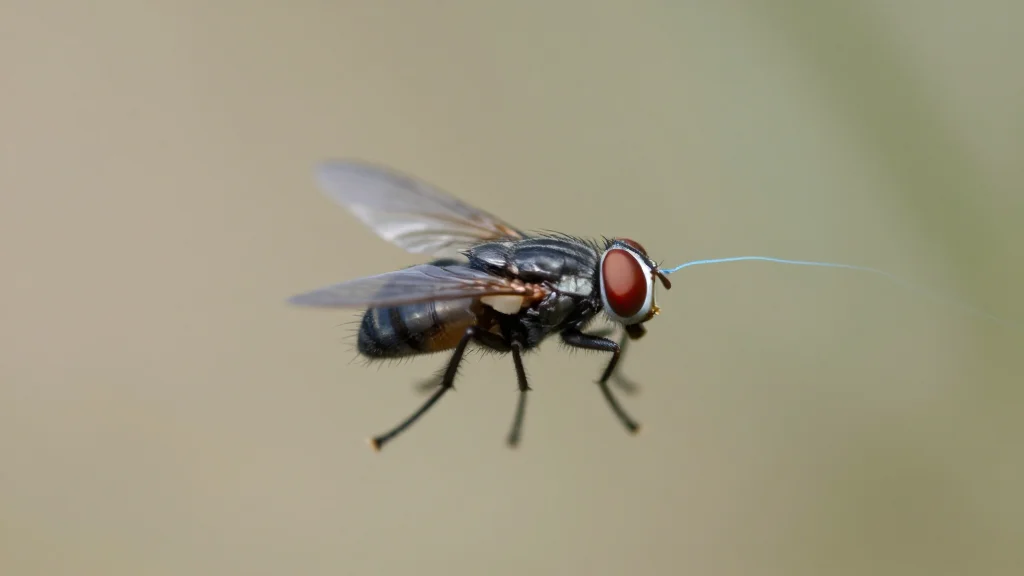
Tiny Insect Brain Discovery Offers a Blueprint for Faster and More Efficient AI and Robots
Why It Matters
By mimicking insects' active vision, AI hardware can achieve dramatic gains in speed and power efficiency, a critical advantage for autonomous vehicles, drones, and edge‑computing robots. The research offers a tangible path to reduce computational load while maintaining real‑time responsiveness.
Key Takeaways
- •Flies use high‑frequency jumping to triple visual data rate
- •Movement‑driven sensing cuts neural lag to milliseconds
- •Blueprint could slash AI energy use in robots
- •Adaptive vision may boost autonomous vehicle reaction speed
- •Neuromorphic chips can mimic insect sensor coordination
Pulse Analysis
The discovery of high‑frequency jumping in dipteran vision overturns decades‑old assumptions that insects process visual input passively. By actively synchronising rapid eye saccades with body movements, flies generate a transient surge of neural firing that temporarily expands the bandwidth of their visual pathway. This "turbo boost" allows critical motion cues to reach the brain before conventional transmission would complete, effectively compressing perception‑to‑action cycles to a few milliseconds. Such a dynamic, context‑dependent routing contrasts sharply with the fixed‑latency pipelines that dominate current computational neuroscience models.
Translating this biological principle into artificial systems promises a paradigm shift for AI hardware. Traditional deep‑learning stacks rely on massive parallel processors and continuous data streams, consuming significant power—especially in mobile or edge applications. By embedding movement‑driven preprocessing, neuromorphic chips could prioritize salient visual streams, discarding irrelevant pixels and reducing the volume of data that must be processed downstream. Autonomous drones, self‑driving cars, and warehouse robots would benefit from faster reaction times and lower energy footprints, extending operational range and improving safety in dynamic environments.
Realising insect‑inspired vision, however, demands interdisciplinary collaboration. Engineers must develop sensors capable of rapid, coordinated actuation, while algorithm designers create adaptive routing protocols that emulate the brain's temporary bandwidth expansion. Early prototypes in event‑based cameras and spiking neural networks already hint at the feasibility, but scaling to commercial-grade robustness remains a hurdle. As venture capital flows toward neuromorphic startups and defense agencies fund bio‑robotics research, the high‑frequency jumping blueprint could become a cornerstone of next‑generation, low‑latency AI, reshaping markets from autonomous transport to smart manufacturing.
Tiny insect brain discovery offers a blueprint for faster and more efficient AI and robots
Comments
Want to join the conversation?
Loading comments...