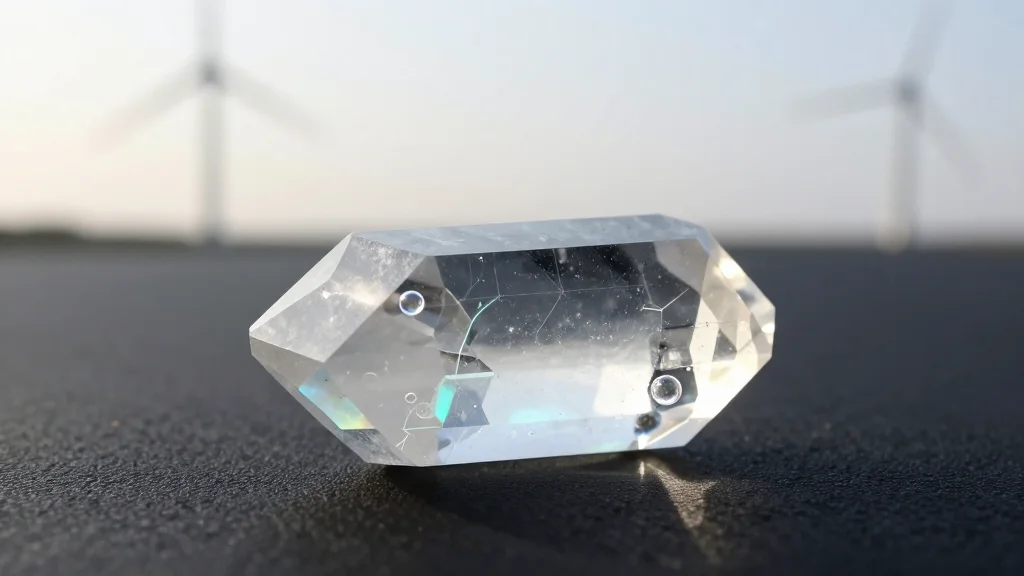
Topological Quantum Materials in Sustainable Energy Conversion: Catalysis and Thermoelectrics
Why It Matters
TQMs combine exotic electronic properties with practical energy functions, offering a pathway to more efficient catalysts and next‑generation thermoelectric devices. Their adoption could accelerate the transition to low‑carbon power generation and waste‑heat recovery.
Key Takeaways
- •Weyl semimetals enable efficient hydrogen evolution catalysis
- •Chiral topological semimetals boost spin-selective oxygen evolution
- •Band inversion in Bi2Te3 raises Seebeck coefficient near room temperature
- •Berry curvature drives anomalous thermopower and Nernst effects
- •High carrier mobility of TSS supports stable electron baths for catalysis
Pulse Analysis
Topological quantum materials have moved from theoretical curiosities to practical platforms for energy conversion. Their defining feature—symmetry‑protected topological surface states—creates a highly conductive electron layer that resists scattering, delivering carrier mobilities far beyond conventional semiconductors. This quantum advantage translates into faster charge transfer at interfaces, a critical factor for both catalytic reactions and thermoelectric performance. As researchers map the electronic landscapes of Weyl, Dirac and chiral semimetals, they uncover design rules that link crystal symmetry to functional properties, opening new avenues for material engineering.
In catalysis, the robust surface states act as a stable electron reservoir, enabling reactions that demand rapid electron exchange. Weyl semimetals such as NbP and NbIrTe4 have demonstrated record‑low overpotentials for hydrogen evolution, while chiral compounds like RhSi and RhBiS exhibit spin‑selective oxygen evolution, a feature that could improve selectivity in electro‑oxidation processes. These breakthroughs stem from the interplay between bulk topology and surface chemistry, where the spin‑momentum locking of topological states reduces recombination losses and enhances reaction kinetics. The result is a new class of catalysts that combine high activity with durability, promising lower energy input for industrial hydrogen production and renewable fuel synthesis.
Thermoelectric applications benefit equally from the quantum architecture of TQMs. Band inversion in tetradymites such as Bi2Te3 and Bi2Se3 creates multiple degenerate valleys, amplifying the Seebeck coefficient while maintaining electrical conductivity. Moreover, the Berry curvature inherent to many topological phases generates anomalous thermopower and a pronounced Nernst effect, enabling transverse energy harvesting and sensitive thermal sensing. Despite these advantages, challenges remain: material synthesis at scale, stability under operating conditions, and integration with existing device architectures. Ongoing research aims to fine‑tune defect chemistry and interface engineering, positioning TQMs as a cornerstone of next‑generation sustainable energy technologies.
Topological Quantum Materials in Sustainable Energy Conversion: Catalysis and Thermoelectrics
Comments
Want to join the conversation?
Loading comments...