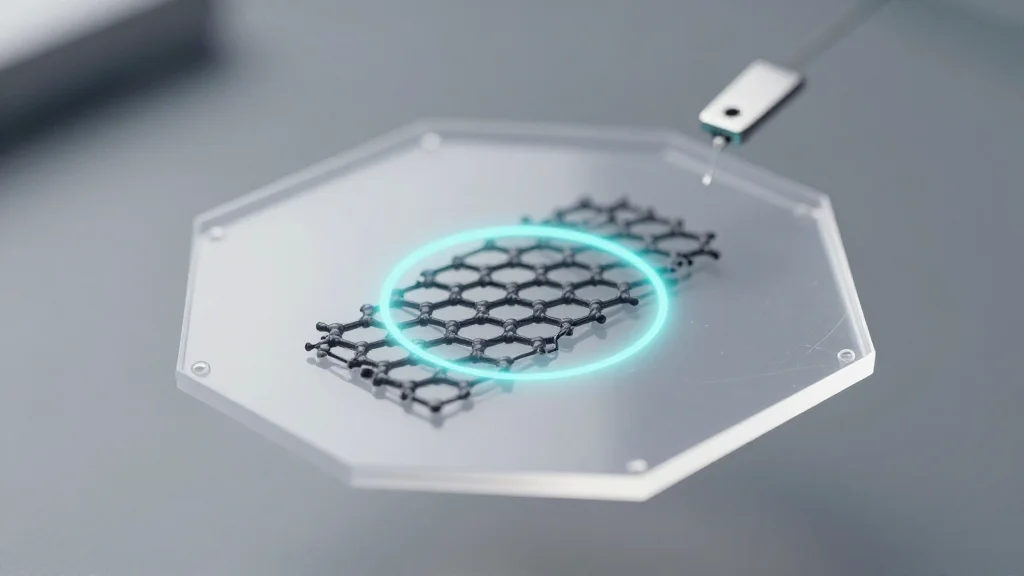
Transdimensional Anomalous Hall Effect in Rhombohedral Thin Graphite
Why It Matters
The discovery introduces a new mechanism for Hall transport in layered carbon systems, opening pathways for ultra‑low‑power, gate‑tunable electronic components. It also broadens the theoretical landscape of anomalous Hall physics beyond traditional ferromagnets and topological insulators.
Key Takeaways
- •TDAHE observed in 9‑layer rhombohedral graphene at zero magnetic field
- •Hall resistance shows hysteresis with both out‑of‑plane and in‑plane fields
- •Phase diagram reveals Stoner ferromagnetism and orbital magnetism coexistence
- •Electrical switching of magnetic order demonstrated via gate‑controlled hysteresis
- •Findings expand anomalous Hall phenomena to transdimensional 2D systems
Pulse Analysis
The team fabricated high‑quality rhombohedral graphite stacks by mechanically exfoliating graphene and encapsulating nine‑layer devices between hexagonal boron nitride crystals. Low‑temperature transport measurements revealed a sizable Hall voltage even when the external magnetic field was nulled, a hallmark of the transdimensional anomalous Hall effect. Systematic angle‑dependent studies, documented in the extended data figures, mapped out a rich phase diagram where out‑of‑plane and in‑plane magnetic hysteresis coexist, confirming the interplay of Stoner‑type ferromagnetism with orbital magnetism across the layered structure.
From a theoretical standpoint, the observed TDAHE challenges the conventional wisdom that anomalous Hall responses require strong spin‑orbit coupling or magnetic ordering confined to a single plane. Instead, the effect emerges from interlayer orbital currents that generate a net transverse voltage, effectively acting as a three‑dimensional Chern insulator within a nominally two‑dimensional material. This transdimensional behavior aligns with recent predictions of orbital ferromagnetism in multilayer graphene and extends earlier reports of quantum anomalous Hall states in twisted and moiré‑engineered systems. By demonstrating that intrinsic Hall transport can arise from purely orbital mechanisms, the study reshapes the taxonomy of Hall phenomena.
Practically, the gate‑tunable hysteresis and electrical switching of magnetic order suggest a route toward energy‑efficient Hall sensors and non‑volatile memory elements that operate without external magnets. Integrating TDAHE devices with existing graphene electronics could enable compact, low‑loss interconnects and novel spin‑orbit‑free spintronic architectures. Future work will likely explore thicker rhombohedral stacks, fractional Hall regimes, and hybridization with superconductivity to unlock even richer topological phases, positioning transdimensional Hall effects as a frontier for next‑generation quantum materials.
Transdimensional anomalous Hall effect in rhombohedral thin graphite
Comments
Want to join the conversation?
Loading comments...