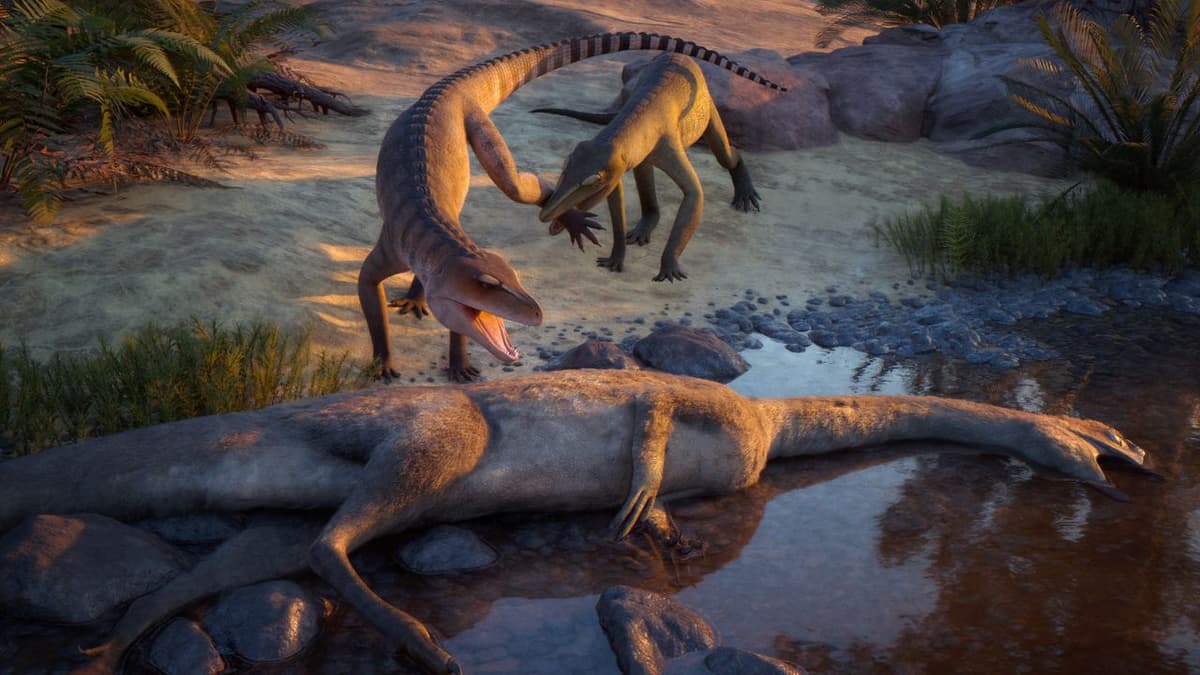
Triassic Croc Relative From Ghost Ranch, New Mexico Finally Identified After Nearly 80 Years in Museum Basement
Why It Matters
Identifying E. lacrimosa reveals early niche partitioning among crocodylomorphs, indicating that functional diversity arose much sooner than previously thought. This insight refines evolutionary models for the lineage that led to modern crocodiles and alligators.
Key Takeaways
- •New genus Eosphorosuchus lacrimosa identified after 75 years in Yale museum basement.
- •Short snout and reinforced skull indicate powerful bite and distinct niche.
- •Coexistence with Hesperosuchus agilis shows early crocodylomorph ecological diversity.
- •Fossil includes skull, leg bone, vertebra, three scales; size of large dog.
- •Study underscores data gaps in early crocodylomorphs; each new find reshapes evolution.
Pulse Analysis
The discovery of Eosphorosuchus lacrimosa underscores how museum collections can harbor undiscovered scientific treasures. While the fossil lay dormant for three‑quarters of a century, modern imaging and comparative anatomy allowed researchers to differentiate it from its contemporaneous relative, Hesperosuchus agilis. This reclassification not only adds a new genus to the early crocodylomorph roster but also provides concrete evidence that these reptiles were already experimenting with varied feeding strategies during the Late Triassic.
Ecologically, the short‑snouted morphology and reinforced cranial structure of E. lacrimosa point to a powerful bite capable of tackling larger or tougher prey than its long‑snouted counterpart. Such niche partitioning suggests that early crocodylomorphs were not a monolithic group but rather a mosaic of specialists adapting to different food sources. This early functional diversification mirrors patterns later seen in modern crocodilians, where snout shape correlates with diet, reinforcing the idea that evolutionary pressures shaping feeding mechanics were active far earlier than the Jurassic radiation.
From a broader paleontological perspective, the find highlights the chronic data deficiency that hampers our grasp of early archosaur evolution. Each new specimen, especially those preserved in unexpected repositories, can dramatically shift phylogenetic trees and ecological reconstructions. As researchers continue to revisit legacy collections with advanced techniques, the narrative of crocodylomorph origins is likely to become increasingly nuanced, offering fresh insights for both academic and enthusiast audiences.
Triassic croc relative from Ghost Ranch, New Mexico finally identified after nearly 80 years in museum basement
Comments
Want to join the conversation?
Loading comments...