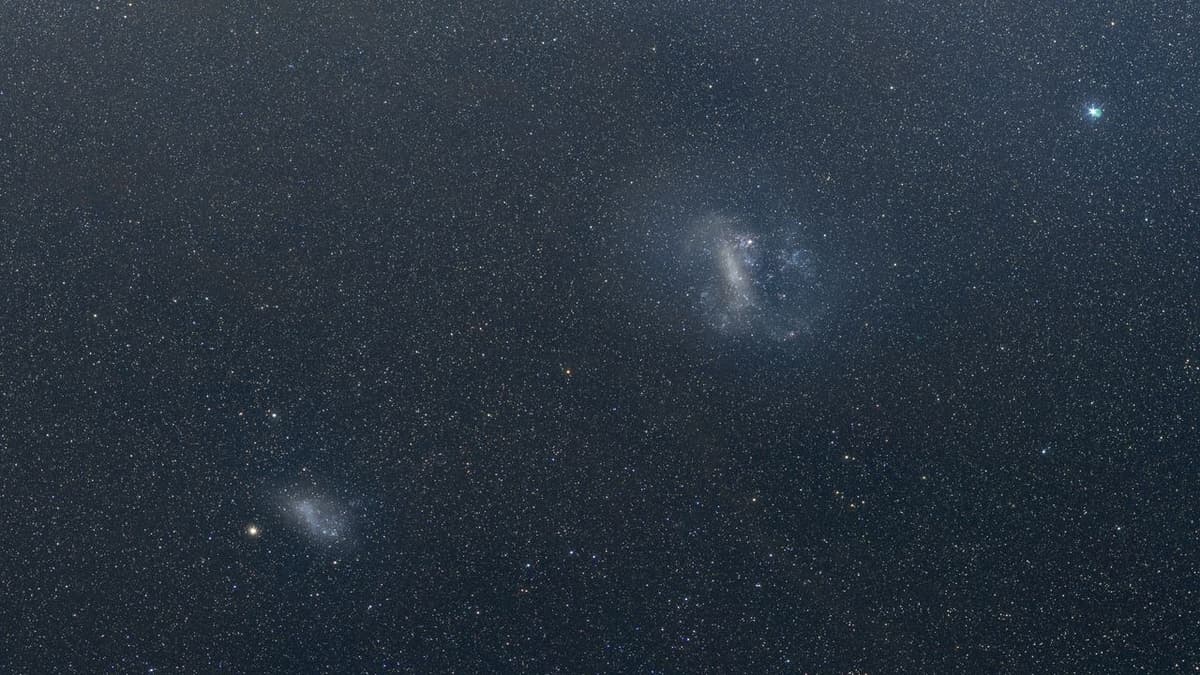
Trouble Near the Milky Way: The Large Magellanic Cloud Is Ripping Its Smaller Neighbor Galaxy Apart
Companies Mentioned
Why It Matters
Understanding the LMC‑SMC tidal relationship reshapes models of dwarf‑galaxy evolution and informs predictions of how the Milky Way’s halo will assimilate its companions.
Key Takeaways
- •VISTA maps SMC stars moving outward at 10.6 mph (17 km/s).
- •Tidal forces from LMC stretch SMC, disproving rotating‑disk model.
- •Red giants show northward bulk motion from 2‑billion‑year event.
- •Simulations predict Magellanic Clouds merging with Milky Way billions ahead.
Pulse Analysis
The Large and Small Magellanic Clouds have long been regarded as a pair of dwarf irregular galaxies orbiting the Milky Way, but new VISTA observations reveal a far more dynamic relationship. By tracking stellar motions over an 11‑year baseline, researchers identified a coherent outward flow of stars from the SMC that points directly toward the LMC. This tidal expansion, measured at roughly 17 km s⁻¹, overturns the assumption that the SMC rotates like a miniature spiral and instead paints a picture of a galaxy being stretched and reshaped by its larger sibling.
These findings carry weight for astrophysicists modeling galaxy interactions. The discovery that the SMC’s internal kinematics are dominated by external gravitational pulls forces a revision of simulations that previously treated the dwarf as an isolated rotating disk. Moreover, the distinct northward drift of ancient red‑giant stars suggests a separate, older encounter—potentially a close pass between the Magellanic Clouds two billion years ago, well before they entered the Milky Way’s halo. Such layered interaction histories provide a natural laboratory for studying how tidal forces trigger star formation, strip gas, and alter galactic morphology.
Looking ahead, the Magellanic Clouds are on a slow collision course with the Milky Way, projected to merge in several billion years. The ongoing tidal tug‑of‑war between the LMC and SMC will likely accelerate their eventual assimilation, contributing fresh gas and stellar material to the Galactic halo. For researchers and investors in space‑related technologies, these insights underscore the importance of long‑term monitoring of satellite galaxies, as their evolution can influence future missions targeting the Milky Way’s outskirts and inform the broader narrative of cosmic structure formation.
Trouble near the Milky Way: The Large Magellanic Cloud is ripping its smaller neighbor galaxy apart
Comments
Want to join the conversation?
Loading comments...