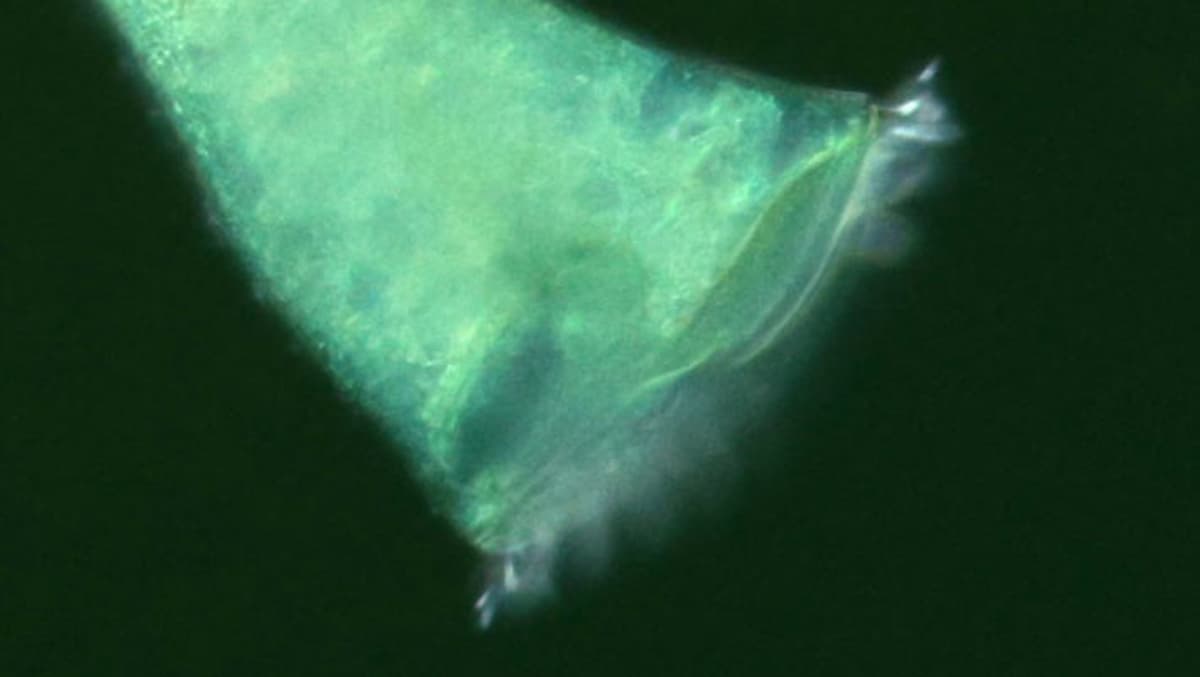
Trumpet-Shaped Unicellular Microorganism, Drawn to Corners, Reveals Hidden Sense of Geometry
Why It Matters
The finding reveals that even the simplest life forms exploit physical geometry to survive, reshaping our understanding of microbial habitat selection and informing the design of microfluidic systems that manipulate cell behavior.
Key Takeaways
- •Stentor coeruleus prefers anchoring in tight corners over flat surfaces
- •Shape shift enables passive geometric sensing without neural processing
- •Corner anchoring enhances feeding efficiency via vortical flows
- •Study used microfabricated chambers to quantify geometry-driven behavior
- •Findings inform microbial ecology and microfluidic device design
Pulse Analysis
At the microscale, physical cues often dominate over chemical signals, and *Stentor coeruleus* exemplifies this principle. The organism’s ability to detect and migrate toward angular niches stems from a simple morphological adjustment that redirects ciliary motion, creating a passive steering mechanism. This discovery challenges the notion that sophisticated sensory pathways are required for spatial navigation, suggesting that geometry itself can serve as an information channel for unicellular life.
The research team engineered a suite of micro‑chambers with precisely controlled corner angles and depths, allowing quantitative tracking of swimming trajectories. Video analysis paired with numerical simulations showed a statistically significant bias toward tighter corners, where the protist’s elongated trumpet shape facilitates stable attachment. Once anchored, the membranellar band generates localized vortical flows that draw in bacteria and small ciliates, boosting nutrient capture while shielding the cell from predators. These insights deepen our grasp of how micro‑habitat structure influences community assembly and biofilm formation in natural aquatic systems.
Beyond biology, the study offers practical lessons for microengineering. Designers of lab‑on‑a‑chip platforms can harness geometric cues to guide cell placement, improve sorting efficiency, or create protective niches for beneficial microbes. Moreover, synthetic biologists may emulate *Stentor*'s passive geometry sensing to develop autonomous microswimmers that navigate complex environments without onboard computation. As researchers explore the interplay between shape, flow, and behavior, the work opens new avenues for controlling microbial dynamics in both ecological research and industrial biotechnology.
Trumpet-Shaped Unicellular Microorganism, Drawn to Corners, Reveals Hidden Sense of Geometry
Comments
Want to join the conversation?
Loading comments...