Why It Matters
Controllable crystal chirality opens a new design space for chiral electronics, optical components and enantioselective technologies, potentially creating high‑value market opportunities. Demonstrating a practical switching pathway accelerates the translation of fundamental symmetry concepts into commercial material platforms.
Key Takeaways
- •NbOCl₂ exhibits both chiral and achiral crystal phases
- •Electric field lowers energy of one enantiomer, enabling switching
- •Charge‑density wave drives structural distortion between chiral states
- •Intermediate achiral phase bridges enantiomeric transition
- •Method could apply to other layered NbOX₂ compounds
Pulse Analysis
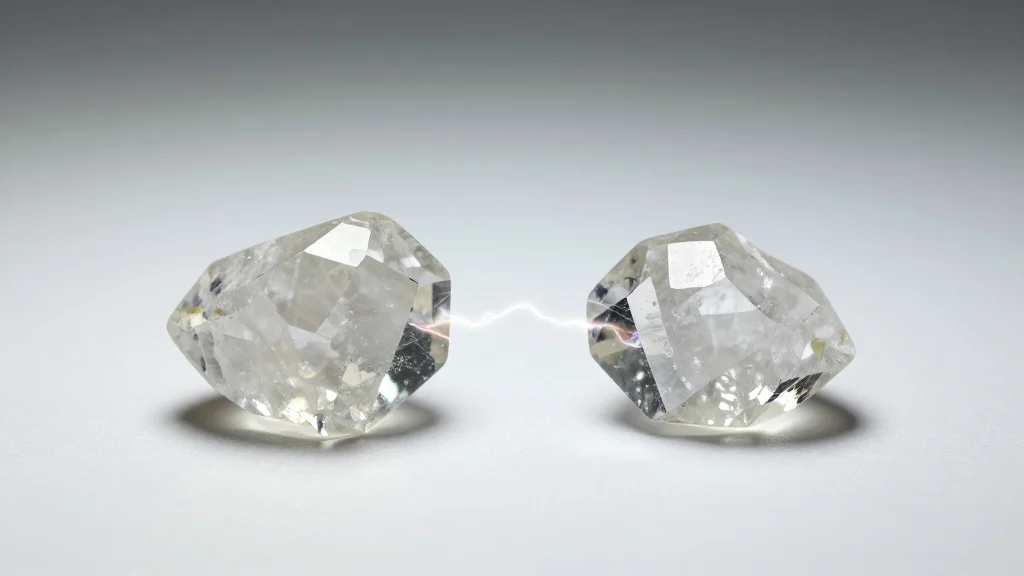
Chirality—an object’s handedness—has long fascinated physicists, but harnessing it in solid‑state materials remained elusive. Traditional approaches relied on static molecular arrangements, limiting practical applications. The recent Aalto University study changes that narrative by showing that a van der Waals crystal, NbOCl₂, can be coaxed between right‑handed and left‑handed configurations through external stimuli. This breakthrough stems from a detailed computational mapping of the material’s energy landscape, revealing a hidden achiral intermediate that acts as a structural conduit for enantiomeric conversion. By leveraging electric fields, temperature shifts, or pressure, the energy gap between the two chiral states can be modulated, effectively turning a crystal’s handedness on demand.
At the heart of the transition lies a charge‑density wave, a periodic modulation of electron density that triggers subtle lattice distortions. In NbOCl₂, these distortions differentiate the chiral and achiral phases, while the intermediate phase provides a low‑energy pathway for the crystal to flip its handedness. The researchers’ first‑principles simulations demonstrate that an applied electric field preferentially stabilizes one enantiomer, reducing the activation barrier enough for practical switching. Similar effects are predicted under modest pressure or temperature variations, suggesting a versatile toolbox for material engineers seeking dynamic control over symmetry properties.
The ability to toggle chirality on command could ripple across multiple high‑tech sectors. In photonics, chiral crystals enable direction‑dependent light manipulation, paving the way for compact isolators and circulators. In electronics, enantiomeric states may encode binary information, offering a novel route to non‑volatile memory with potentially lower energy consumption. Moreover, the concept could be extended to other NbOX₂‑type compounds, expanding the library of switchable chiral materials. As industry looks for next‑generation functional materials, this discovery positions tunable chirality as a strategic asset for innovation pipelines ranging from quantum devices to enantioselective catalysis.
Tuning Chirality in Crystals
Comments
Want to join the conversation?
Loading comments...