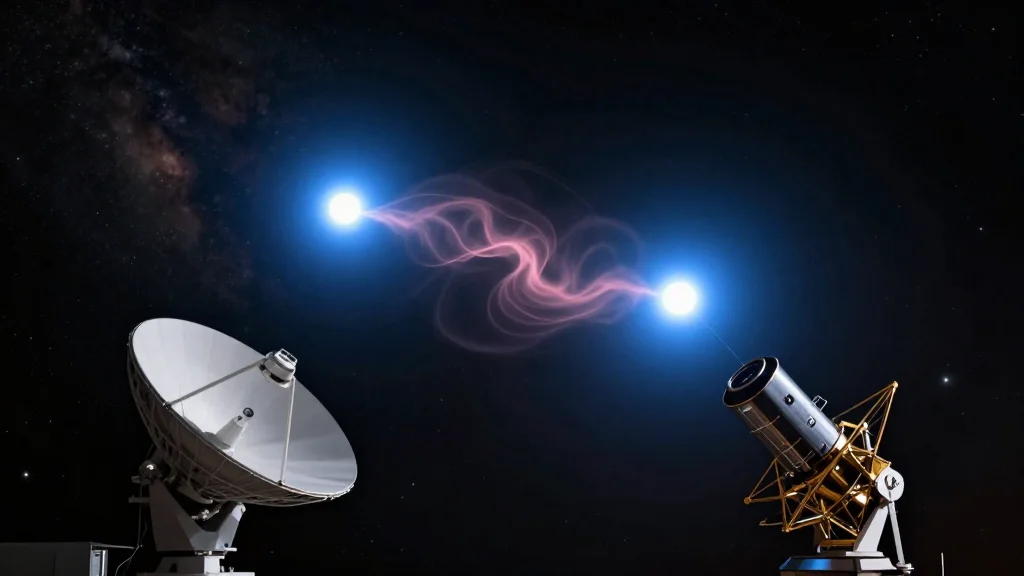
Twin Quasars Merging in Early Universe Linked by Cosmic Gas Bridge

Why It Matters
The observation of a merging quasar pair at redshift 5.7 provides a direct laboratory for studying how the first massive galaxies assembled and how their central black holes grew in tandem. By confirming that a tidal gas bridge can physically link two active nuclei, the finding validates a key pathway—merger‑driven accretion—long hypothesized but rarely witnessed at such early times. Beyond astrophysics, the result showcases the synergistic power of next‑generation facilities. ALMA’s millimeter precision combined with JWST’s infrared sensitivity enables researchers to pierce the dust and capture the faint signatures of early‑universe structures, setting a template for future surveys targeting the elusive population of high‑redshift quasar pairs.
Key Takeaways
- •Twin quasars J2037–4537 confirmed at redshift z = 5.7, less than 1 billion years after the Big Bang.
- •ALMA observations reveal a cold, star‑forming gas bridge linking the two active galactic nuclei.
- •JWST infrared data helped rule out gravitational lensing, confirming both sources are distinct.
- •Only two quasar pairs at z > 5 have been verified, highlighting the rarity of such systems.
- •The discovery supports merger‑driven black‑hole growth models for the early universe.
Pulse Analysis
The J2037–4537 system arrives at a moment when the astronomical community is eager to reconcile the existence of supermassive black holes with the limited time available for their formation. Traditional models relying on steady, Eddington‑limited accretion fall short of producing billion‑solar‑mass black holes by redshift six. The observed gas bridge offers a concrete mechanism for delivering copious fuel quickly, suggesting that major mergers could accelerate growth far beyond the average rates assumed in many simulations.
Historically, quasar pairs have been identified primarily at lower redshifts, where the universe is more mature and the observational challenges are fewer. The leap to z > 5 pushes the frontier of what instruments can resolve, and the success of ALMA and JWST together signals a new era of high‑redshift, multi‑wavelength studies. Future facilities such as the next‑generation Very Large Array (ngVLA) and the Extremely Large Telescope (ELT) will likely expand the sample size, turning rare anecdotes into statistical populations.
From a broader perspective, the detection underscores the importance of coordinated, cross‑facility campaigns. As more early‑universe mergers are cataloged, researchers will be able to test whether the tidal‑bridge phenomenon is a common precursor to the most massive black holes we see today. The next steps—tracking gas dynamics, measuring inflow rates, and modeling the eventual coalescence—will refine our understanding of how the cosmic web seeded the massive structures that dominate the modern universe.
Twin Quasars Merging in Early Universe Linked by Cosmic Gas Bridge
Comments
Want to join the conversation?
Loading comments...