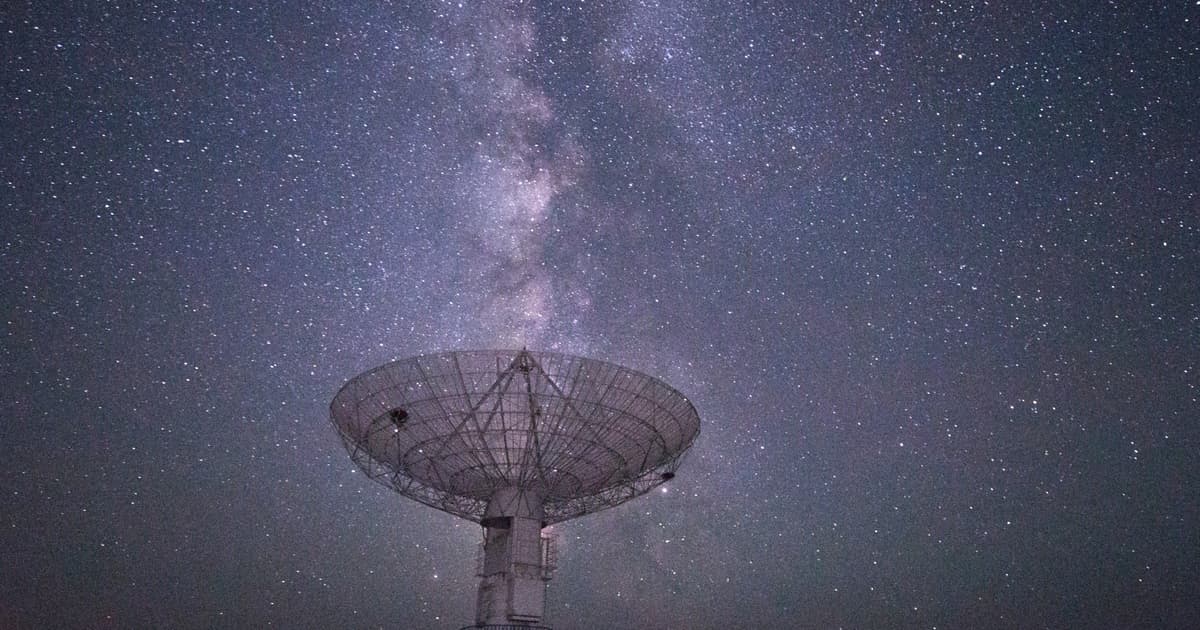
Two Radio Astronomers Spent Months Trying to Eliminate a Faint Hiss in Their Antenna, Even Scrubbing Out Pigeon Droppings, Before Realising the Noise They Couldn’t Get Rid of Was the Afterglow of the Early Universe — the Cosmic Microwave Background Left Behind by the Big Bang.
Why It Matters
The CMB provided the first empirical evidence that the universe began in a hot, dense state, shifting scientific consensus toward the Big Bang and opening a new observational window into the cosmos’ infancy.
Key Takeaways
- •Penzias and Wilson detected 3.5 K excess radiation in 1965.
- •The signal was isotropic, matching Big Bang predictions.
- •Discovery earned the 1978 Nobel Prize in Physics.
- •Instrument originally built for Project Echo, not cosmology.
- •Methodical noise elimination underscored value of rigorous calibration.
Pulse Analysis
The Holmdel Horn Antenna, a massive horn‑shaped microwave receiver designed for Project Echo’s satellite‑bounce experiments, became an unlikely tool for cosmology when Bell Labs repurposed it as a radio telescope. Penzias and Wilson meticulously accounted for every conceivable source of interference—electronic noise, atmospheric emission, even the white dielectric of pigeon droppings—yet a faint excess persisted. Their disciplined approach, rooted in precise calibration, turned a nuisance hiss into a measurable antenna temperature of about 3.5 kelvin, a value that would soon reshape our view of the universe.
When the duo shared their puzzling data with Robert Dicke’s Princeton group, the match was striking: theory predicted a uniform microwave glow left over from a hot, dense origin. The CMB’s isotropy and black‑body spectrum provided the missing observational pillar for the Big Bang model, displacing the steady‑state alternative that had dominated mid‑20th‑century cosmology. The 1975 joint publication not only earned a Nobel Prize but also sparked a cascade of experiments—COBE, WMAP, and Planck—that refined the CMB’s temperature map to microkelvin precision, revealing subtle anisotropies that encode information about cosmic inflation, dark matter, and dark energy.
Beyond its scientific impact, the discovery underscores a timeless lesson: breakthroughs often arise from scrupulous attention to experimental detail rather than grand hypotheses. Modern CMB observatories invest billions in cryogenic receivers, ultra‑clean optics, and rigorous foreground subtraction, echoing the painstaking methodology of Penzias and Wilson. For today’s engineers and researchers, the story is a reminder that eliminating “noise” can reveal the universe’s deepest signals, turning what seems like a problem into a paradigm‑shifting insight.
Two radio astronomers spent months trying to eliminate a faint hiss in their antenna, even scrubbing out pigeon droppings, before realising the noise they couldn’t get rid of was the afterglow of the early universe — the cosmic microwave background left behind by the Big Bang.
Comments
Want to join the conversation?
Loading comments...