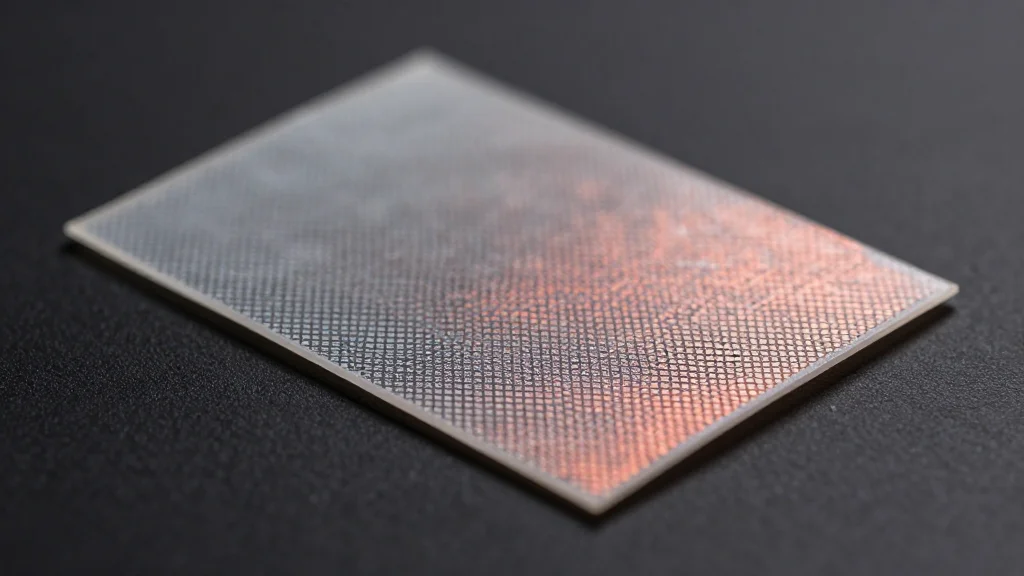
Ultra‐stable Flexible Thermal Sensing Operating From 20 to 1273 K Enabled by the Directly Grown Mo2C Patterns on Flexible Substrates
Why It Matters
The breakthrough offers a scalable path to robust, high‑temperature flexible sensors, closing a critical gap for aerospace, energy and industrial monitoring where conventional flexible electronics fail.
Key Takeaways
- •Directly grown Mo2C on mica eliminates transfer steps
- •Sensors function continuously from –253 °F to 2,300 °F
- •Thermal stability proven at 873 K for four hours
- •Temperature coefficient of resistance reaches 1.7% per kelvin
- •Inkjet cycles tune film thickness and resistance range
Pulse Analysis
Flexible electronics have transformed wearables and low‑power devices, yet their adoption in harsh environments remains limited by material degradation at elevated temperatures. Transition metal carbides, especially Mo2C, combine metallic conductivity with exceptional mechanical strength, making them prime candidates for next‑generation sensors. However, integrating such ceramics onto pliable substrates without compromising adhesion or inducing defects has been a persistent obstacle, often requiring complex lithography or transfer processes that add cost and reduce yield.
The new inkjet‑printing and hydrogen‑assisted thermal reduction approach sidesteps these hurdles by depositing a precursor directly onto mica and converting it in‑situ at 750 °C. This method yields uniform Mo2C patterns with controllable thickness (10‑70 nm) and resistance (0.1‑2 kΩ) simply by adjusting printing cycles. The strong interfacial bonding delivers unprecedented thermal stability—continuous operation up to 1273 K and four‑hour endurance at 873 K—while maintaining a fast 26 ms response and a high temperature coefficient of resistance (1.7%/K) in the extreme‑heat regime.
The implications extend beyond laboratory demonstrations. Industries such as aerospace propulsion, deep‑well drilling, and high‑temperature manufacturing demand sensors that can endure rapid thermal cycling and sustained heat without failure. By providing a cost‑effective, scalable fabrication route, this technology could accelerate the deployment of smart monitoring systems in turbines, furnaces, and hypersonic vehicles. Moreover, the flexibility of the mica substrate opens avenues for conformal sensor arrays on curved surfaces, potentially reshaping predictive maintenance and real‑time diagnostics across high‑risk sectors.
Ultra‐stable Flexible Thermal Sensing Operating from 20 to 1273 K Enabled by the Directly Grown Mo2C Patterns on Flexible Substrates
Comments
Want to join the conversation?
Loading comments...