Key Takeaways
- •Schlieren visualizes density gradients via refractive index changes
- •Spherical mirror setup offers compact, high‑sensitivity system
- •Technique reveals invisible gases, buoyant plumes, shock waves
- •Enables rapid diagnostics in aerospace and combustion research
- •Various schlieren configurations have distinct optical trade‑offs
Summary
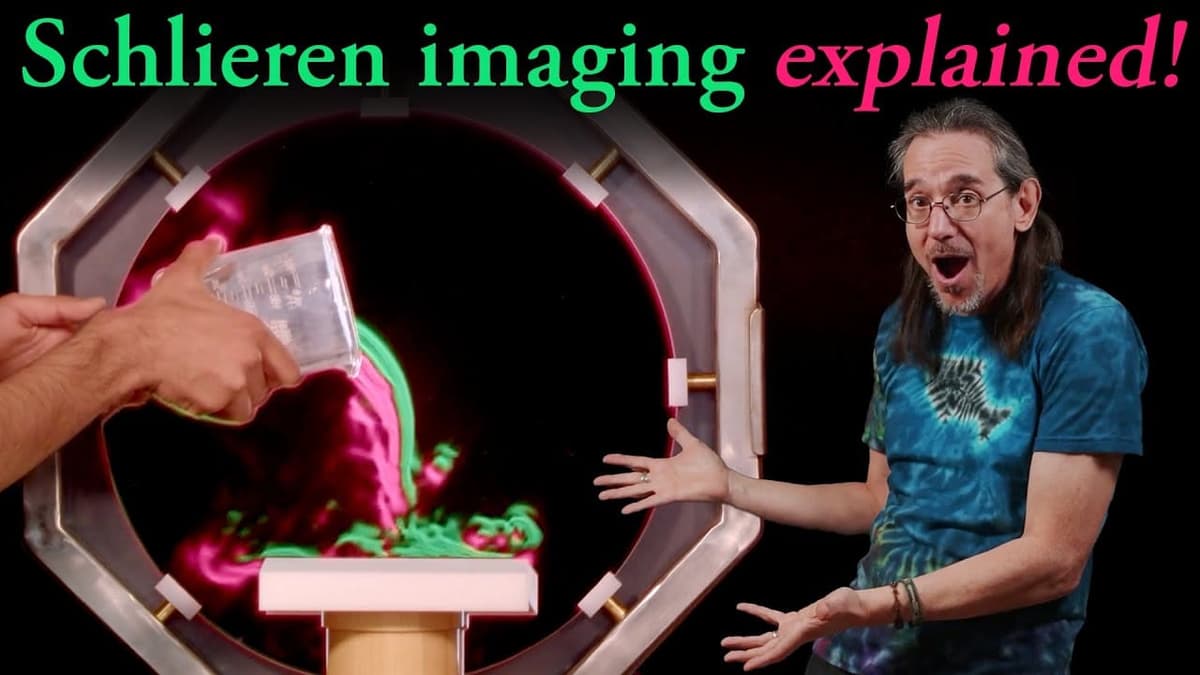
The article explains schlieren imaging, an optical technique that makes density variations in fluids visible. It focuses on a spherical‑mirror configuration that can render invisible gases, candle plumes, and shock waves detectable on camera. Sample images show carbon‑dioxide vortex rings and buoyant plumes captured with the method. A linked video by physicist David Jackson demonstrates the setup, while noting that multiple schlieren designs exist, each with unique quirks.
Pulse Analysis
Schlieren imaging transforms subtle density gradients into visible light patterns, allowing scientists to study otherwise invisible fluid behavior. By exploiting the refractive index shift that occurs when air or gas density changes, a simple optical path—often a point light source, a knife edge, and a camera—produces high‑contrast images of plumes, vortices, and shock fronts. This principle underpins a broad class of flow visualization tools used in laboratories and industry, delivering real‑time insight without intrusive probes.
The spherical‑mirror variant highlighted in the article offers a compact yet powerful configuration. A concave mirror focuses the light beam, enhancing sensitivity to minute refractive variations while keeping the apparatus footprint small enough for tabletop experiments. Researchers leverage this design to capture rapid events such as candle‑driven buoyant plumes or carbon‑dioxide vortex rings, where traditional cameras would see only clear air. The setup’s simplicity translates to lower capital costs, making high‑fidelity optical diagnostics accessible to academic labs, aerospace firms, and HVAC developers alike.
Beyond academic curiosity, schlieren techniques are integral to modern engineering workflows. In aerospace, engineers use them to validate supersonic flow models and detect shock‑wave interactions on test rigs. Combustion specialists apply schlieren to monitor flame front stability and pollutant formation, informing cleaner engine designs. As computational fluid dynamics grows more sophisticated, empirical schlieren data remains a critical benchmark, bridging simulation and reality. Emerging digital sensors and AI‑driven image analysis promise to automate feature extraction, expanding schlieren’s role from visual curiosity to quantitative diagnostic platform.
Comments
Want to join the conversation?