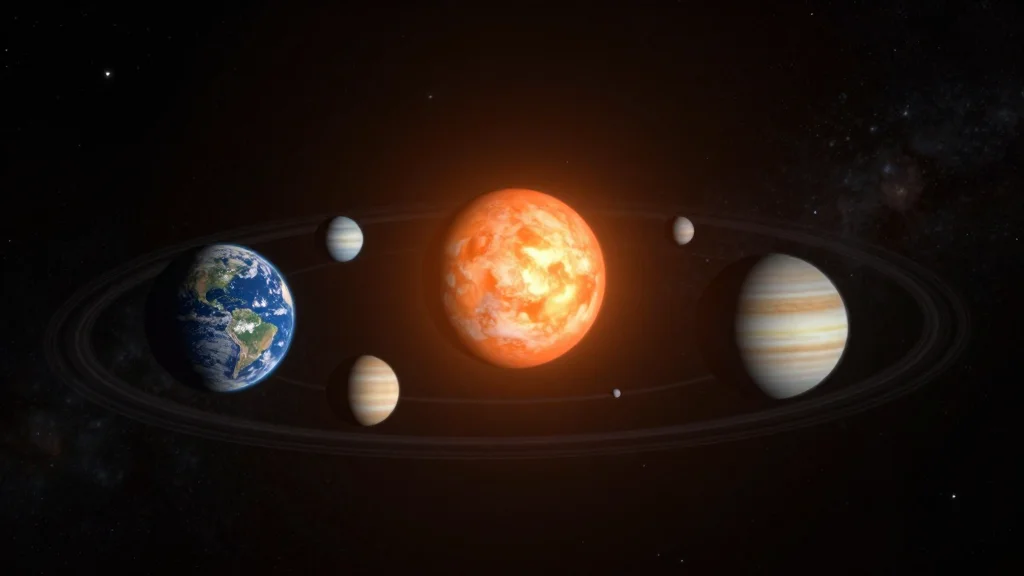
UNM Astronomers Reveal Always-Changing Multi-Planet System
Why It Matters
Dynamic orbital behavior challenges static planetary formation models, prompting a reassessment of system stability across the exoplanet field. The discovery also showcases the analytical power of small‑university research teams in high‑impact astronomy.
Key Takeaways
- •UNM team identified a five-planet system orbiting star K2-155
- •Planets exhibit rapid orbital shifts due to strong mutual gravitational pulls
- •Transit timing variations reveal planet masses ranging from Earth to Neptune
- •Findings challenge static models, suggesting dynamic evolution in compact systems
Pulse Analysis
The exoplanet landscape has expanded dramatically over the past decade, yet most known multi‑planet systems appear relatively stable over astronomical timescales. UNM’s latest detection of a constantly shifting five‑planet arrangement adds a new dimension to this picture, highlighting that some systems remain in a state of flux long after formation. By leveraging high‑precision photometry from NASA’s TESS satellite, the researchers captured subtle variations in transit timing, a technique that can infer planetary masses and orbital interactions without direct imaging.
In this particular system, the planets range from rocky, Earth‑sized bodies to gas‑rich mini‑Neptunes, all packed within a fraction of an astronomical unit from their host star. The observed transit‑timing variations suggest that gravitational tugs are reshaping orbits on timescales of months, a phenomenon rarely seen in other compact systems. Such rapid dynamical evolution implies that these worlds may experience frequent orbital resonances, collisions, or even ejections, offering a natural laboratory for testing theories of planetary migration and stability.
The broader implications extend beyond academic curiosity. Understanding dynamic multi‑planet environments informs the design of future space telescopes and data‑analysis pipelines, as variable signals demand more sophisticated modeling. Moreover, the discovery underscores the value of collaborative, university‑level research in advancing frontier science, potentially attracting private investment into next‑generation observation platforms. As the catalog of exoplanets grows, recognizing that some systems are inherently unstable will refine target selection for habitability studies and guide the next wave of astrophysical exploration.
UNM Astronomers Reveal Always-Changing Multi-Planet System
Comments
Want to join the conversation?
Loading comments...