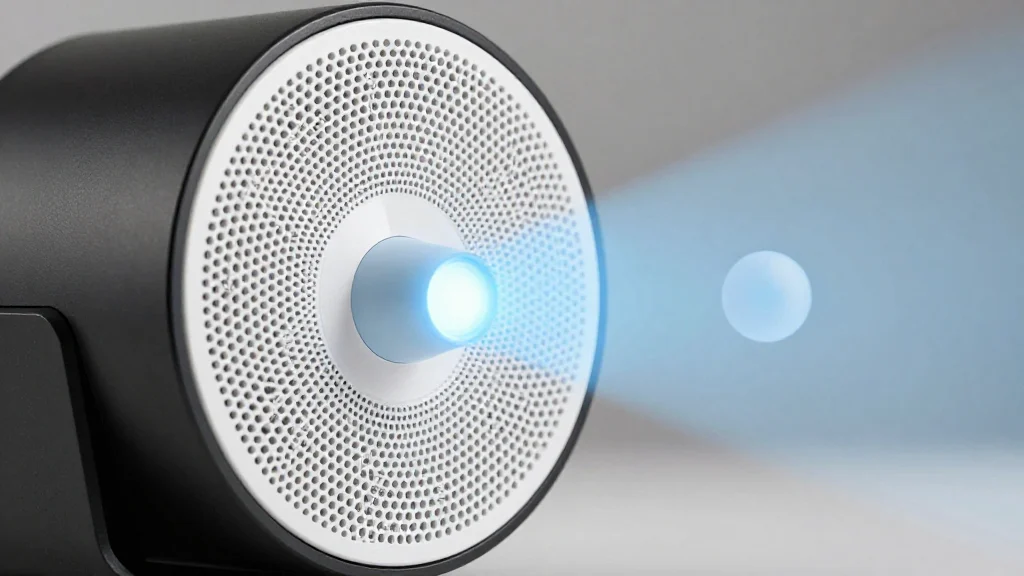
Unpowered Speaker Cover Focuses Sound Into One Select Spot
Why It Matters
The technology enables truly private, localized audio, reducing noise spill and expanding directional sound into consumer‑facing environments.
Key Takeaways
- •3D‑printed acoustic metasurface focuses PAL sound into 4‑inch spot
- •Volume drops 50 dB just 2 inches from focal point
- •Low‑frequency response reaches 38 Hz, improving bass in directional audio
- •Potential uses include ATMs, kiosks, museums, and car infotainment
- •Device works only with parametric array speakers, not conventional speakers
Pulse Analysis
Directional audio has long been a niche solved by parametric array loudspeakers (PALs), which emit ultrasonic carriers that demodulate into audible sound in a narrow beam. While PALs eliminate the need for headphones, they suffer from poor bass reproduction and unwanted reflections when the beam strikes surfaces, limiting their deployment to controlled spaces such as museums. Penn State’s approach leverages acoustic metasurfaces—engineered thin structures that manipulate wavefronts—to refine the PAL output, effectively turning the ultrasonic beam into a precision lens for sound.
The 3D‑printed metasurface creates a focal zone roughly four inches from the speaker, where measured sound pressure levels remain high, but drop by as much as 50 decibels just two inches later. This steep attenuation translates to a “bubble” of audible audio that can be heard clearly by a single listener while remaining inaudible to anyone nearby. Moreover, the prototype reproduces frequencies down to 38 Hz, a significant improvement over traditional PALs that typically struggle below 100 Hz, thereby delivering richer bass without bulky subwoofers.
By coupling the metasurface with existing PAL hardware, manufacturers could embed private audio zones into ATMs, ticket kiosks, retail displays, or vehicle cabins, allowing multiple users to receive individualized messages without cross‑talk. The requirement for a PAL source, however, means the solution is not a drop‑in retrofit for conventional speakers, and scaling production of the precisely patterned metasurface will demand reliable additive‑manufacturing processes. If these hurdles are overcome, the technology could reshape public sound design, offering a new layer of acoustic privacy in crowded urban settings.
Unpowered speaker cover focuses sound into one select spot
Comments
Want to join the conversation?
Loading comments...