Why It Matters
Understanding the cosmic web refines estimates of dark energy and the universe’s expansion rate, directly impacting fundamental physics and future cosmological models. The DESI hint of evolving dark energy could reshape theories that drive billions in research funding and technology development.
Key Takeaways
- •DESI measured 13 million galaxies, revealing larger BAO distances.
- •BAO data suggest dark energy may weaken over time.
- •Hubble constant tension persists, linking to cosmic web observations.
- •Upcoming Euclid, Roman, Rubin surveys will map billions of galaxies.
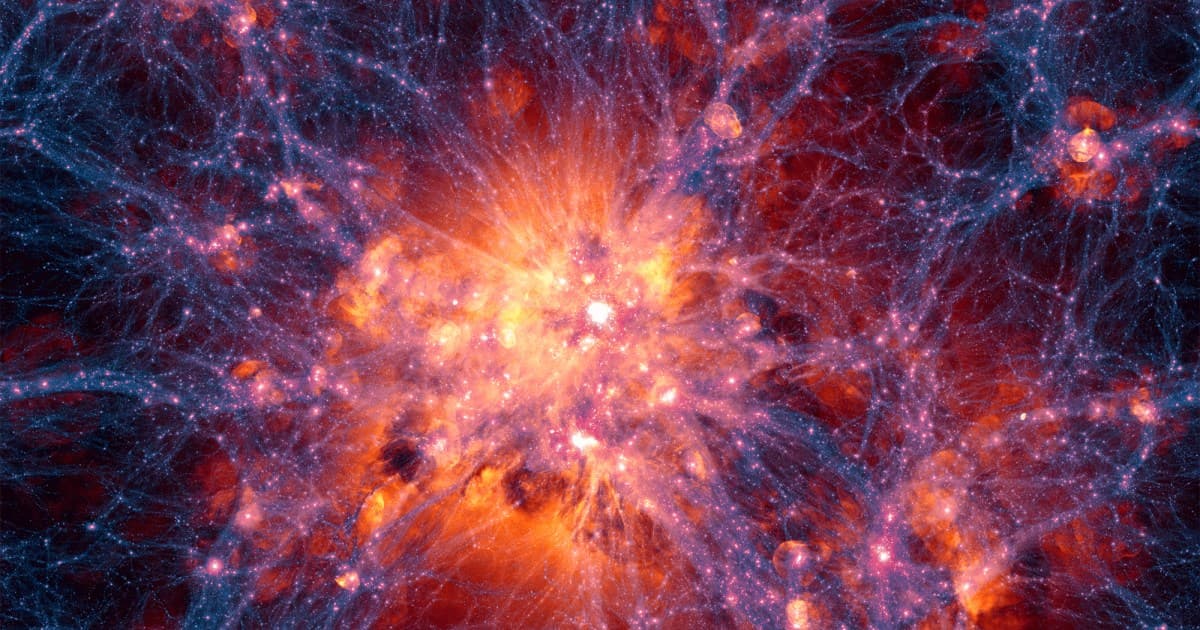
- •Simulations show dark matter essential for observed large‑scale structures.
Pulse Analysis
The cosmic web is the universe’s largest pattern, a three‑dimensional scaffold of clusters, filaments, walls and voids that stretches across more than 90 billion light‑years. Dark matter provides the invisible scaffolding that pulls ordinary matter together, while dark energy pushes the fabric apart, accelerating expansion on the largest scales. By tracing the distribution of galaxies, astronomers can infer the underlying dark‑matter skeleton and gauge how dark energy reshapes the web over billions of years, offering a direct probe of the forces that dominate 95% of the cosmos.
In April 2025 the Dark Energy Spectroscopic Instrument (DESI) released a landmark analysis of baryon acoustic oscillations (BAOs) from a sample of 13 million galaxies. The BAO standard ruler—about a billion light‑years across—appeared slightly larger than predictions from the conventional ΛCDM model, suggesting a modest weakening of dark energy with time. This subtle deviation aligns with the growing Hubble‑constant tension, where local measurements disagree with early‑universe estimates, and positions the cosmic web as a critical laboratory for testing whether new physics or evolving dark energy can reconcile the discrepancy.
Future surveys will push these insights to unprecedented depth. Europe’s Euclid mission, NASA’s Nancy Grace Roman Telescope, and the ground‑based Vera C. Rubin Observatory will together catalog billions of galaxies, map cosmic shear, and characterize voids with exquisite precision. Coupled with massive cosmological simulations, these datasets will tighten constraints on dark‑matter properties, test the stability of dark energy, and refine the cosmic distance ladder. For the scientific community and the high‑tech industry that supports it, the next decade promises a data‑driven revolution in our understanding of the universe’s ultimate fate.
Untangling the cosmic web
Comments
Want to join the conversation?
Loading comments...