Why It Matters
The comet offers a real‑time laboratory for studying solar wind behavior and volatile release, informing both scientific research and emerging space‑industry applications such as in‑situ resource utilization.
Key Takeaways
- •Comet C/2025 R3 (PanSTARRS) visible pre‑dawn for 10 days
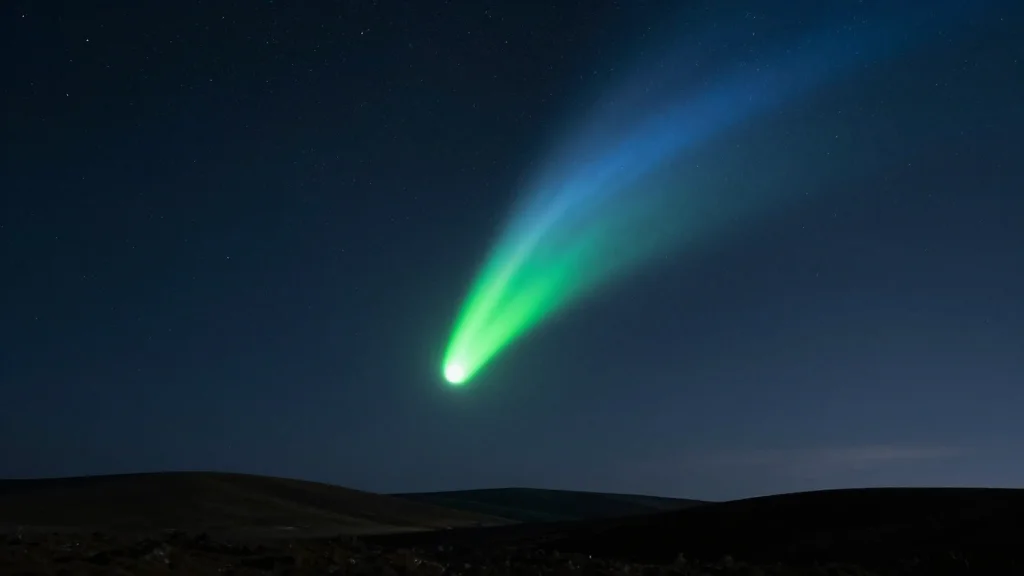
- •Ion tail’s blue hue caused by solar‑wind‑driven ionization
- •Green coma indicates release of water‑rich volatile gases
- •APOD exposure drives public interest in near‑Earth objects
- •Data aids models of solar wind‑comet interactions
Pulse Analysis
The latest Astronomy Picture of the Day puts comet C/2025 R3 (PanSTARRS) front and center, offering a vivid illustration of how solar radiation transforms icy bodies into glowing spectacles. As the Sun’s ultraviolet photons strike the comet’s nucleus, they liberate neutral gases that form a bright green coma. Those gases become ionized and are then accelerated by the solar wind, creating the characteristic light‑blue ion tail that stretches across the sky. This process not only provides a striking visual but also serves as a natural experiment for heliophysicists seeking to map the structure and variability of the solar wind in real time.
For the commercial space sector, the comet’s activity is more than a curiosity. Understanding volatile release mechanisms is critical for future in‑situ resource utilization (ISRU) projects that aim to harvest water and other compounds from small bodies. The data gathered from C/2025 R3’s tail dynamics can refine extraction techniques and inform spacecraft design for safe navigation through cometary environments. Moreover, the heightened public exposure through APOD fuels interest in near‑Earth objects, potentially expanding the talent pipeline for aerospace engineering and planetary science.
From an observational standpoint, C/2025 R3 offers a rare window for both amateur and professional astronomers. Its visibility from northern latitudes before dawn for the next ten days, followed by a shift to southern skies, creates a staggered viewing schedule that can support coordinated multi‑site campaigns. Such campaigns improve the temporal resolution of tail morphology studies, feeding into more accurate predictive models of comet behavior. In turn, these models enhance risk assessments for satellite operators and inform space weather forecasting, underscoring the broader economic relevance of what might otherwise be seen as a purely scientific event.
Untitled
Comments
Want to join the conversation?
Loading comments...