Why It Matters
The comet’s permanent exit provides a live case study of how planetary gravitation can eject small bodies, informing models of Solar System dynamics and future mission planning. Understanding cometary decay aids both scientific research and commercial interests in near‑Earth objects.
Key Takeaways
- •Comet C/2025 R3 PanSTARRS will exit Solar System permanently
- •Tail length shrank dramatically as comet moved beyond inner Solar System
- •Gravitational interactions with planets gave comet a one‑way trajectory
- •Observations captured near Cerro Paranal illustrate comet’s fading activity
- •Study offers insights into cometary evolution and solar wind dynamics
Pulse Analysis
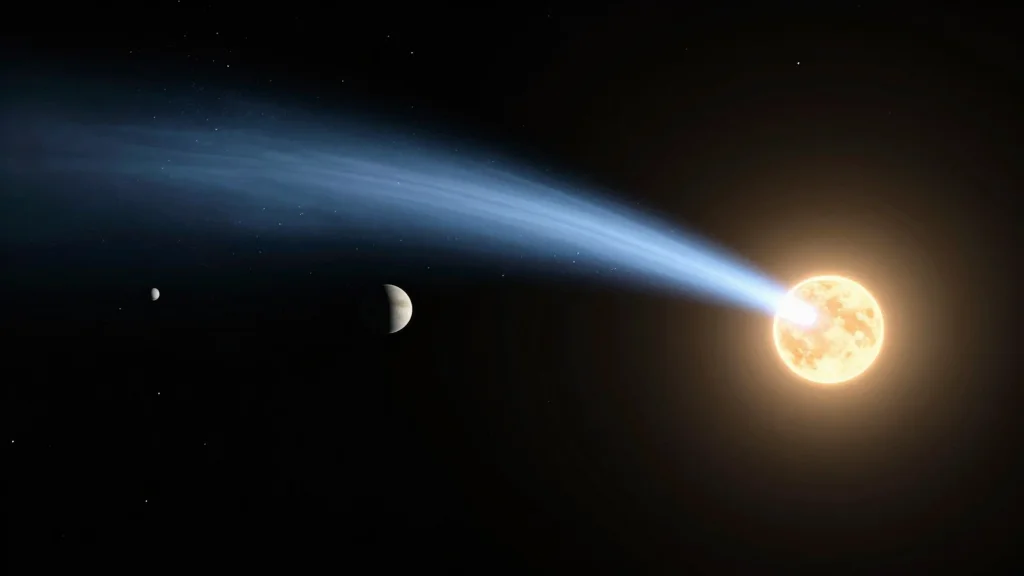
The latest Astronomy Picture of the Day highlights comet C/2025 R3 (PanSTARRS) captured over several nights in May 2026 from the Paranal Observatory in Chile. The sequence of images documents a striking reduction in the ion tail, a visual testament to the comet’s cooling as it moves away from the Sun’s intense radiation. Such high‑resolution, time‑lapse observations are rare, offering astronomers a clear window into the physical processes that govern cometary activity during outbound journeys.
From a scientific perspective, R3 PanSTARRS presents a textbook example of how planetary gravitational assists can alter a small body’s orbit dramatically. Interactions with the giant planets have imparted enough kinetic energy to eject the comet from the inner Solar System, ensuring it will not return for millennia. This phenomenon helps refine orbital dynamics models and improves predictions for other near‑Earth objects that might pose impact risks or become targets for exploration. Researchers also gain valuable data on how cometary nuclei decompose, shedding dust and gas at diminishing rates as solar heating wanes.
Beyond pure research, the event carries implications for the burgeoning commercial space sector. Understanding comet disintegration and tail formation informs the design of future missions aimed at sampling or mining volatile‑rich bodies. Moreover, public fascination with cometary displays fuels outreach and education, supporting broader investment in space science. As R3 PanSTARRS fades into the outer reaches, it leaves a legacy of data that will shape both academic inquiry and commercial strategies for years to come.
Untitled
Comments
Want to join the conversation?
Loading comments...