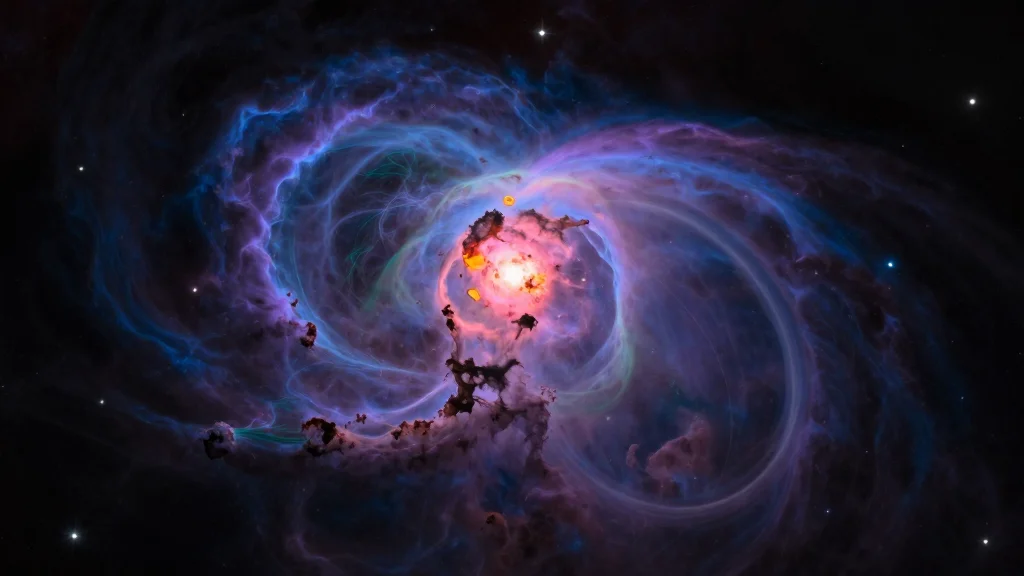
Why It Matters
Confirming a supernova remnant so close to the central black hole would sharpen models of stellar death, feedback, and star‑formation cycles in the Galaxy’s most extreme environment.
Key Takeaways
- •Blue blob may be 1,700‑year‑old supernova remnant
- •Located ~260 light‑years from Milky Way’s central black hole
- •Image blends optical, radio, X‑ray data from several observatories
- •Remnant would rank among closest supernovae near Galactic Center
- •Insights could link massive star deaths to new star formation
Pulse Analysis
The latest APOD release highlights how modern astronomy leverages complementary wavelengths to dissect complex regions like Sagittarius C. Optical surveys from PanSTARRS map the background stellar field, while MeerKAT’s radio sensitivity reveals dense gas clouds, and Chandra together with XMM‑Newton pinpoints high‑energy X‑ray emissions. This layered approach not only produces a striking visual but also isolates distinct physical processes—stellar nurseries, shock fronts, and magnetic turbulence—within a 50‑light‑year‑wide nebula situated roughly 26,000 light‑years from Earth.
A supernova remnant this close to the Milky Way’s supermassive black hole is exceptionally rare. The hypothesized 1,700‑year‑old explosion offers a natural laboratory for studying how massive‑star deaths inject energy and heavy elements into an environment already dominated by intense gravitational forces and strong magnetic fields. Understanding that feedback loop is crucial for refining theories of star‑formation efficiency in galactic nuclei, where dense gas can both fuel new stars and be disrupted by powerful outflows.
Future confirmation will likely involve deeper X‑ray spectroscopy and high‑resolution radio interferometry, possibly with the upcoming Square Kilometre Array and next‑generation X‑ray missions. Pinpointing the remnant’s age, composition, and expansion rate will feed into broader models of galactic evolution, informing how central black holes and surrounding stellar populations co‑evolve. For the astrophysics community, this discovery underscores the value of coordinated, multi‑facility observations in unraveling the Milky Way’s most hidden and dynamic regions.
Untitled
Comments
Want to join the conversation?
Loading comments...