Companies Mentioned

NASA
Why It Matters
Understanding galaxy collisions informs astrophysical models that underpin space‑technology development and deep‑space navigation, while the imaging techniques demonstrate advances useful to commercial satellite optics.
Key Takeaways
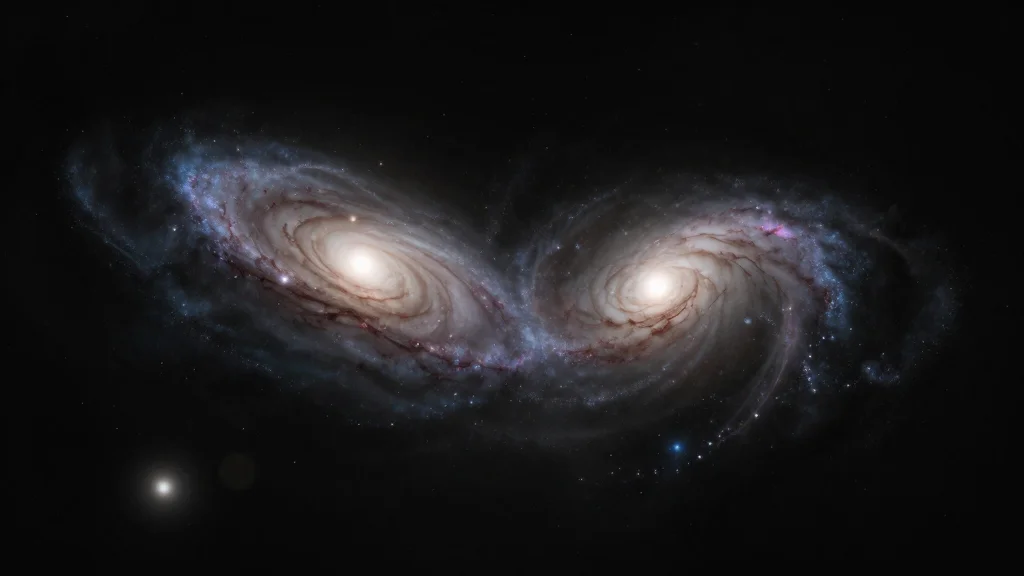
- •Antennae galaxies NGC 4038/4039 are 60 million light‑years away
- •Collision triggers massive star formation in molecular gas clouds
- •Tidal forces fling star clusters over 50,000 light‑years
- •Image captured by Mike Selby, processed by Roberto Colombari
- •Arp 244, dubbed “The Antennae”, illustrates galaxy merger dynamics
Pulse Analysis
Galaxy mergers like the Antennae pair are laboratories for studying how gravity reshapes cosmic structures. When two massive spirals intersect, their interstellar media collide, compressing gas clouds and igniting bursts of star formation that can outshine entire dwarf galaxies. Researchers track these processes to refine simulations of large‑scale structure formation, which in turn influence predictions for dark matter distribution and the future trajectory of the Milky Way’s own eventual merger with Andromeda.
The latest APOD image highlights the technical strides made in ground‑based astrophotography. Using adaptive optics and sophisticated post‑processing, Mike Selby captured fine details of tidal tails and distant background galaxies that were previously only visible from space‑based platforms. Such capabilities have commercial spillover: high‑resolution imaging informs Earth‑observation satellite design, improves optical sensor calibration, and supports navigation systems that rely on precise star‑tracker data for deep‑space missions.
Beyond pure science, the Antennae’s dramatic visuals capture public imagination, bolstering support for NASA’s Artemis program and related commercial ventures. As Artemis II prepares for its upcoming splashdown, the public’s exposure to cutting‑edge space imagery reinforces the economic case for continued investment in launch services, orbital infrastructure, and data‑analytics platforms that turn raw astronomical data into actionable insights for industries ranging from telecommunications to climate monitoring.
Untitled
Comments
Want to join the conversation?
Loading comments...