Why It Matters
Laser guide stars unlock high‑resolution imaging for Earth‑bound telescopes, expanding scientific discovery without the cost of space missions. This capability accelerates research in exoplanets, galaxy formation, and cosmology.
Key Takeaways
- •Lasers create artificial guide stars for adaptive optics
- •Guide stars correct atmospheric distortion in real time
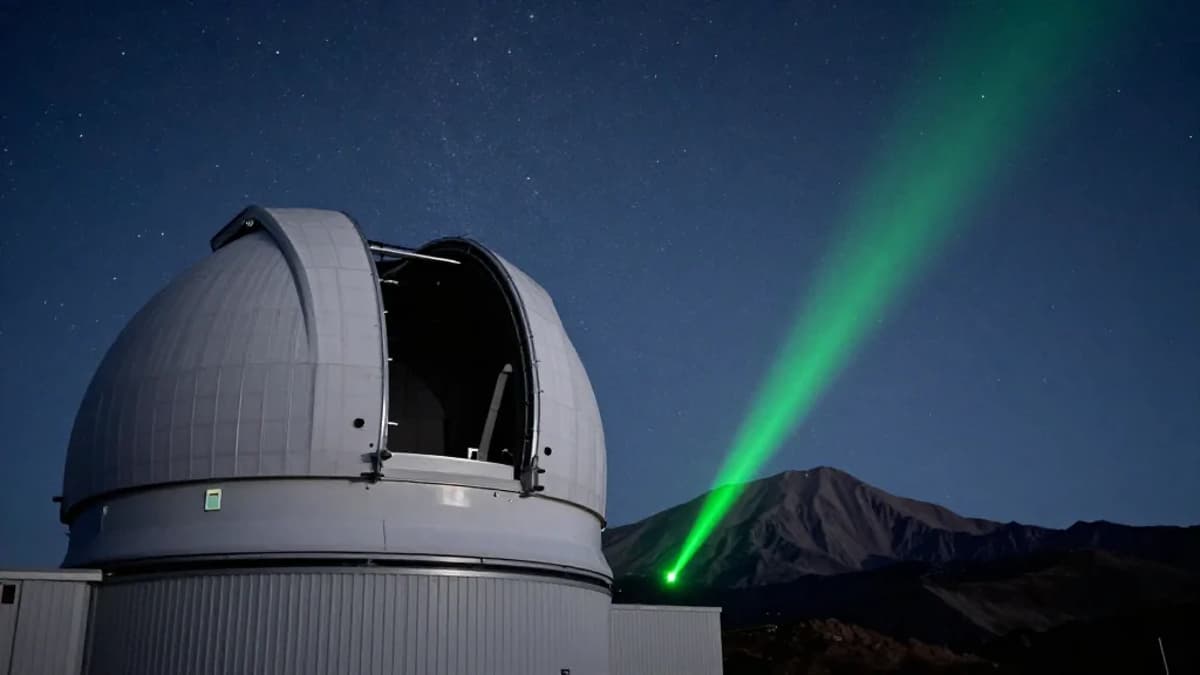
- •Paranal telescopes use lasers to sharpen observations
- •Adaptive optics enable ground telescopes rival space imaging
- •Improved clarity advances exoplanet and galaxy research
Pulse Analysis
Adaptive optics began as a solution to the blurring effect of Earth’s atmosphere on astronomical observations. By projecting a focused laser beam into the sky, observatories create an artificial star whose light traverses the same turbulent layers as distant celestial objects. Sensors track the apparent wobble of this guide star, feeding data to deformable mirrors that adjust thousands of times per second. This real‑time correction restores the telescope’s diffraction‑limited performance, delivering crisp images that were once only possible from orbiting platforms.
At Paranal Observatory, home to the Very Large Telescope array, laser guide star systems are integral to daily operations. The lasers, often invisible to the naked eye, emit at a wavelength that excites sodium atoms high in the mesosphere, producing a bright, pinpoint reference. Coupled with sophisticated wavefront sensors, the system compensates for atmospheric fluctuations across a wide field of view. Researchers can now resolve fine details on distant exoplanets, map the intricate structures of nebulae, and conduct deep surveys of distant galaxies with unprecedented clarity, all from the ground.
The broader impact of laser‑assisted adaptive optics reshapes the economics and strategy of astronomical research. By reducing reliance on costly space telescopes, institutions can allocate resources to larger, more versatile ground facilities. Future upgrades promise even higher correction speeds and multi‑laser constellations, further narrowing the gap between terrestrial and space‑based observations. As the technology matures, its applications may extend beyond astronomy into fields like satellite tracking and atmospheric science, cementing laser guide stars as a pivotal tool in modern observational science.
Untitled
0
Comments
Want to join the conversation?
Loading comments...