Why It Matters
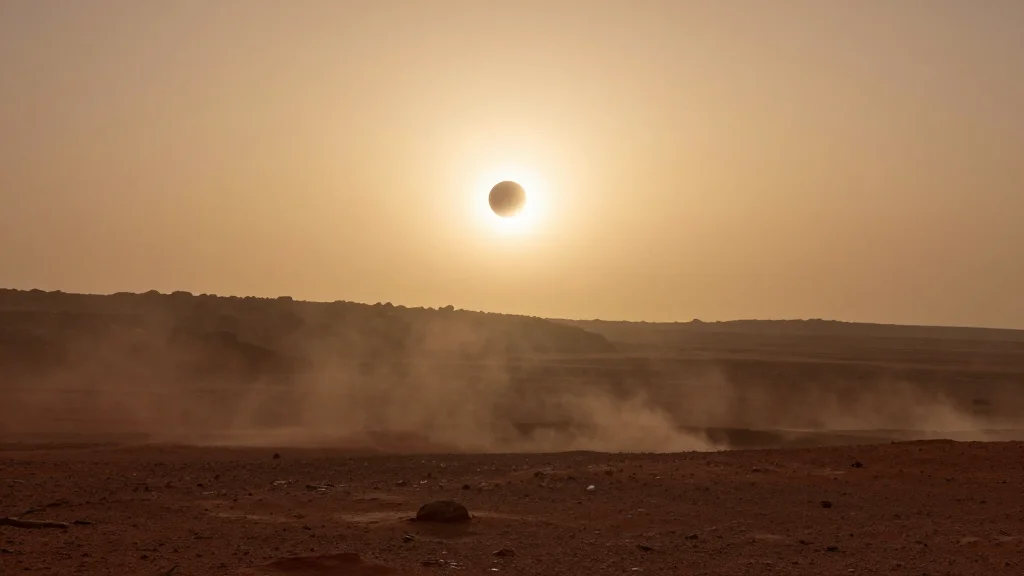
The real‑time eclipse provides rare insight into Martian orbital mechanics and solar illumination, informing models of atmospheric heating and surface conditions while showcasing Perseverance’s capability to deliver high‑impact visual science to the public.
Key Takeaways
- •Phobos spans ~11.5 km, 150× smaller than Earth's Moon
- •It orbits 50× closer to Mars, causing rapid solar eclipses
- •Phobos will likely disintegrate and hit Mars in ~50 million years
- •Perseverance captured a 40‑second eclipse video in 2022
- •Footage showcases Mars’ dynamic sky and rover’s scientific capabilities
Pulse Analysis
Phobos, Mars’ larger moon, is a battered, irregular body only 11.5 km across—roughly 150 times smaller than Earth’s Moon. Its ultra‑low orbit, about 6,000 km above the Martian surface, means it whizzes around the planet every 7.6 hours, creating solar transits that last mere seconds. Over the next 50 million years tidal forces will tear Phobos apart, eventually raining debris onto the Red Planet. Understanding this decay process helps scientists refine models of planetary ring formation and the long‑term evolution of satellite systems, topics that are central to comparative planetology.
The Perseverance‑captured eclipse offers more than a visual novelty; it provides a precise measurement of solar irradiance attenuation during a Phobos transit. By analyzing the light curve, researchers can infer dust and atmospheric scattering properties unique to Mars, improving climate models that predict temperature swings and dust storm dynamics. Moreover, the rapid cadence of these eclipses—occurring several times each Martian day—creates a natural laboratory for studying how short‑term solar shading influences surface chemistry, especially in regions where perchlorates and other reactive compounds are present.
Beyond the science, the video exemplifies how rover missions extend public engagement. NASA’s APOD platform leverages such striking imagery to translate complex planetary science into accessible stories, fostering broader interest in exploration. Perseverance’s primary goal—searching for biosignatures in Jezero Crater—benefits from the same high‑resolution imaging systems that captured the eclipse, underscoring the mission’s multifaceted value. As future missions like the Mars Sample Return and potential human landings loom, the Phobos eclipse serves as a reminder of the dynamic environment awaiting the next generation of explorers.
Untitled
Comments
Want to join the conversation?
Loading comments...