Why It Matters
Understanding how massive stars sculpt and disperse their birth clouds informs models of star formation and galaxy evolution, guiding future telescope missions and astrophysical research.
Key Takeaways
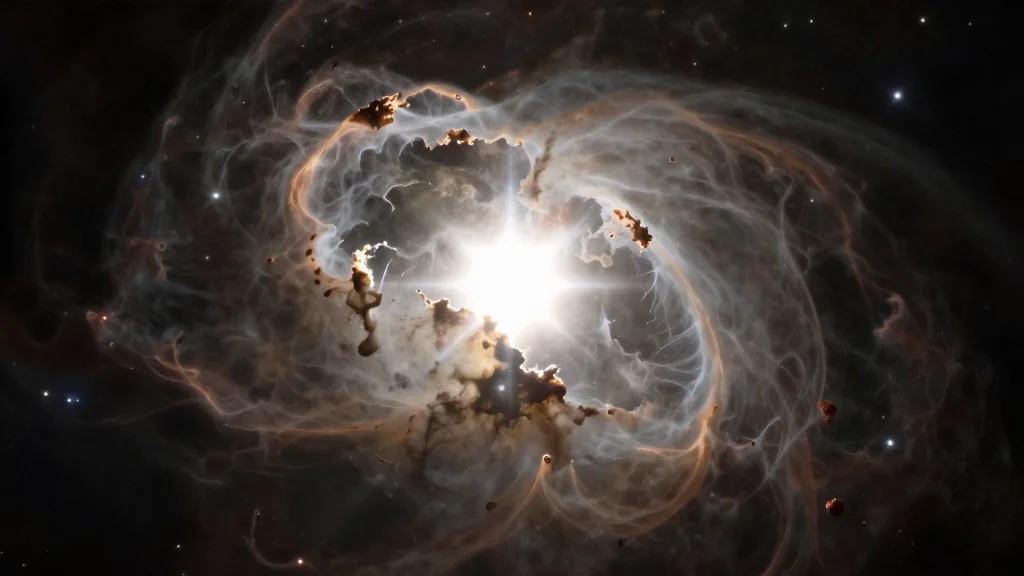
- •Mystic Mountain pillar spans several light‑years in Carina Nebula
- •Hidden star drives Herbig‑Haro jets that erode the pillar
- •Hubble captured high‑resolution image revealing dust and gas structures
- •Pillar expected to evaporate within a few million years
Pulse Analysis
The Carina Nebula, located roughly 7,500 light‑years from Earth, is one of the Milky Way’s most active star‑forming regions. Its iconic pillars, often dubbed “Mystic Mountain,” are dense filaments of dust and hydrogen gas that serve as incubators for newborn stars. By studying the morphology of these structures, astronomers can trace the interplay between gravity, turbulence, and radiation pressure that governs how stars coalesce from interstellar material. The Hubble Space Telescope’s high‑resolution imaging provides unprecedented detail, revealing the intricate knots and shadows that betray the underlying physical processes.
At the heart of the featured pillar lies a concealed protostar whose powerful Herbig‑Haro jets pierce the surrounding dust. These bipolar outflows, composed of high‑energy particles, act like cosmic blowtorches, heating and dispersing the nebular material. As the jets collide with ambient gas, they generate shock fronts that illuminate the otherwise opaque clouds, creating the luminous filaments captured in the photograph. Over the next few million years, the combined effect of the protostar’s jets and the intense ultraviolet radiation from neighboring massive stars will erode the pillar, eventually leaving only a faint wispy remnant.
The transient nature of such pillars underscores the importance of timely observations. Each generation of space telescopes—from Hubble to the upcoming James Webb Space Telescope and the Nancy Grace Roman Space Telescope—offers new wavelengths and sensitivities to monitor the evolution of these stellar nurseries. By mapping the lifecycle of pillars like Mystic Mountain, scientists refine theoretical models of star formation efficiency and feedback mechanisms, which are critical for predicting galaxy‑scale star‑birth rates. Moreover, the striking visuals serve as a powerful outreach tool, inspiring public interest in astrophysics and reinforcing the value of continued investment in space science.
Untitled
Comments
Want to join the conversation?
Loading comments...