Why It Matters
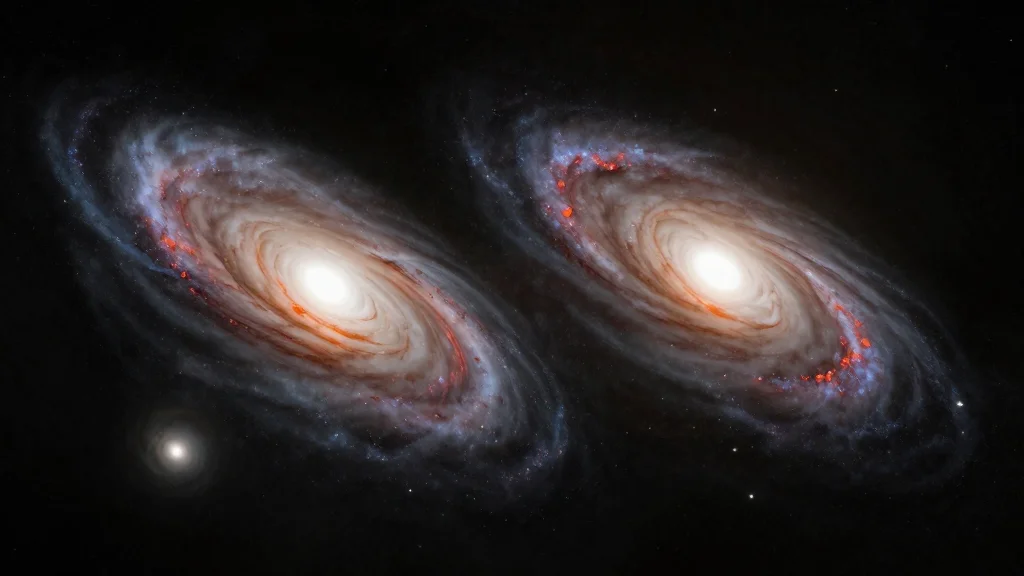
Understanding galaxy mergers like NGC 3169/3166 informs models of cosmic evolution and the growth of supermassive black holes, key topics for astrophysics and future space missions.
Key Takeaways
- •NGC 3169 and NGC 3166 are gravitationally interacting
- •Interaction creates tidal tails and stellar plumes
- •The pair lies ~70 million light‑years from Earth
- •Image spans ~400,000 light‑years across the group
- •NGC 3169 hosts an active nucleus with a supermassive black hole
Pulse Analysis
Galaxy mergers are a cornerstone of cosmic structure formation, reshaping stellar populations and fueling central black holes. When massive spirals like NGC 3169 encounter a companion such as NGC 3166, tidal forces stretch their disks into elongated tails, redistributing gas and stars. These interactions trigger bursts of star formation and can channel material toward the galactic core, accelerating the growth of an active galactic nucleus. Observing such events in the relatively nearby universe provides a live laboratory for testing simulations that predict how galaxies evolve over billions of years.
The NGC 3169 group offers a vivid illustration of these processes. Situated roughly 70 million light‑years away, the system’s tidal features are visible across multiple wavelengths—from radio maps that trace cold gas to X‑ray images that reveal high‑energy emissions from the active nucleus. The APOD image captures a 20‑arc‑minute field, translating to about 400,000 light‑years, and includes the smaller, bluish NGC 3165, adding depth to the visual narrative. Multi‑spectral data confirm that NGC 3169’s supermassive black hole is actively accreting material, making the galaxy a bright source from radio to X‑ray bands.
For the scientific community, such nearby mergers are invaluable. They calibrate theoretical models, guide the design of next‑generation observatories, and help predict the frequency of similar events in the early universe. As space telescopes like the James Webb Space Telescope and upcoming missions probe deeper, the detailed study of NGC 3169 and its companions will refine our understanding of how galactic ecosystems coalesce, evolve, and ultimately shape the large‑scale structure of the cosmos.
Untitled
Comments
Want to join the conversation?
Loading comments...