Why It Matters
Markarian’s Chain provides a vivid, observable example of galaxy clustering and coherent motion, offering insights into dark matter distribution and cluster dynamics that shape the local cosmic environment.
Key Takeaways
- •Markarian’s Chain lies ~50 million light‑years away in Virgo Cluster
- •M84 and M86 anchor the chain’s visible arc in the image
- •Interacting pair NGC 4438/NGC 4435 dubbed “Markarian’s Eyes.”
- •Virgo Cluster contains ~2,000 galaxies influencing the Local Group
- •Seven chain galaxies move coherently; others are chance alignments
Pulse Analysis
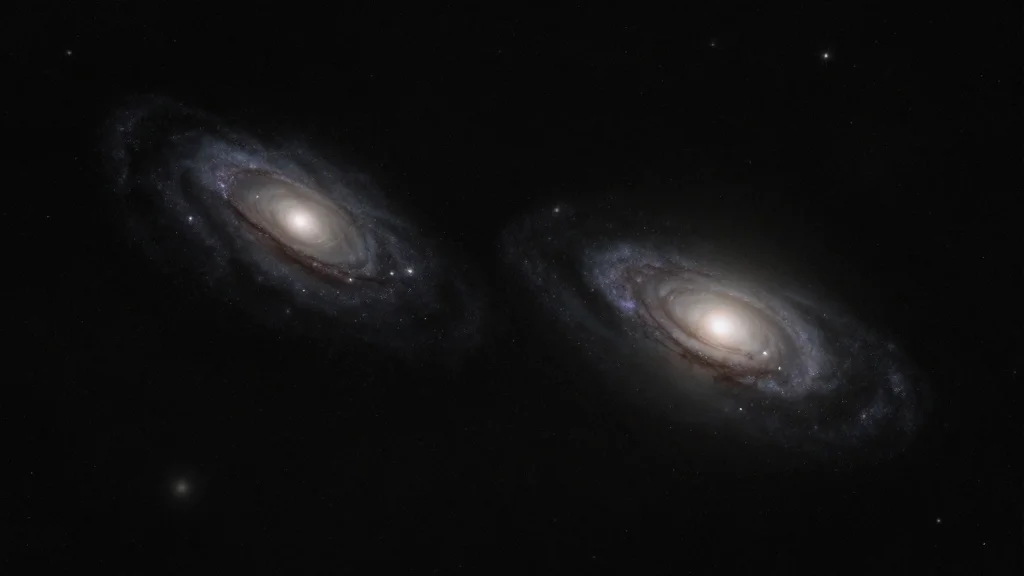
The latest Astronomy Picture of the Day showcases Markarian’s Chain, a striking filament of galaxies threading through the core of the Virgo Cluster. Centered on lenticular giants M84 and M86, the image captures the graceful arc that stretches toward the left, punctuated by the interacting pair NGC 4438 and NGC 4435—often called “Markarian’s Eyes.” At an estimated distance of 50 million light‑years, this structure offers a vivid illustration of how galaxies assemble in dense environments, making it a compelling visual for both professional astronomers and the public.
The Virgo Cluster, home to roughly 2,000 galaxies, exerts a measurable gravitational pull on our own Local Group, subtly shaping its motion through space. Within Markarian’s Chain, at least seven galaxies share a common velocity vector, indicating true physical association rather than a chance line‑of‑sight projection. This coherent movement provides astronomers with a natural laboratory to study dark matter distribution and tidal interactions in a crowded cosmic neighborhood. Conversely, galaxies that merely appear in the chain illustrate the challenges of disentangling three‑dimensional structures from two‑dimensional images.
Beyond its scientific merit, the APOD feature serves as a gateway for public engagement, translating complex extragalactic dynamics into an accessible visual story. NASA’s decision to follow the image with a glimpse of Titan underscores the platform’s commitment to showcasing diverse planetary and astrophysical phenomena. For researchers, high‑resolution observations of Markarian’s Chain can refine distance measurements and calibrate models of galaxy evolution within clusters. As telescopes like the James Webb Space Telescope and upcoming ground‑based observatories target similar structures, the chain will likely become a benchmark for testing theories of hierarchical assembly.
Untitled
Comments
Want to join the conversation?
Loading comments...