Why It Matters
The observation provides direct visual evidence of how massive stars influence nearby star formation, informing models of stellar evolution and interstellar medium dynamics. Such high‑resolution data help refine predictions for future missions and guide research investment in astrophysics.
Key Takeaways
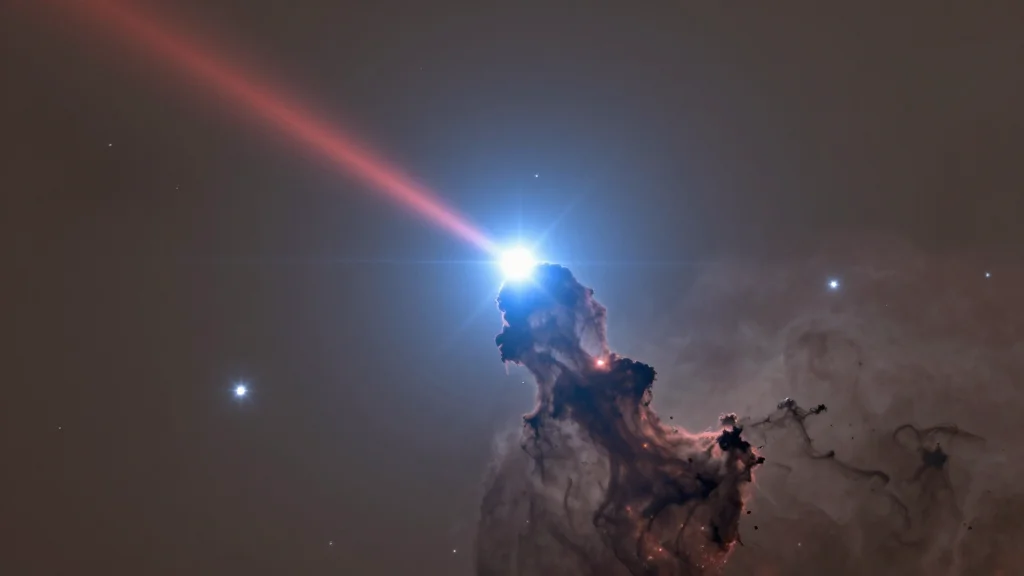
- •Hubble captured a 1‑light‑year jet emerging from Trifid Nebula pillar
- •Bright dots in image are newly formed stars within dense gas
- •Radiation from a massive star strips gas from a nearby protostar
- •Pillar erosion will expose hidden jet source over ~20,000 years
- •APOD showcases star‑formation insights using Hubble’s high‑resolution imaging
Pulse Analysis
The Astronomy Picture of the Day on May 3, 2026 showcases a high‑resolution Hubble image of the Trifid Nebula, also known as M20. The photograph reveals a towering dust pillar, a smaller companion pillar, and an elongated jet that stretches nearly a light‑year across space. These structures are illuminated by nearby massive stars, allowing astronomers to study the interplay between intense radiation fields and dense molecular clouds. The bright points scattered across the pillars are nascent stars, offering a snapshot of a region in the throes of stellar birth.
Astrophysicists view such pillars as natural laboratories for understanding star formation under extreme conditions. The jet, visible only because of external illumination, likely originates from a hidden protostar whose accretion disk is being stripped by the glare of a brighter neighboring star. This process illustrates how massive stars can both trigger and suppress nearby star formation, shaping the evolution of entire nebular complexes. The estimated 20,000‑year timeline for the pillar’s erosion underscores the dynamic, ever‑changing nature of the interstellar medium.
Looking ahead, the detailed morphology captured by Hubble informs the design of next‑generation observatories like the James Webb Space Telescope and the upcoming Nancy Grace Roman Space Telescope. By comparing these observations with infrared and sub‑millimeter data, researchers can map the chemical composition and temperature gradients within the pillars, refining theoretical models of cloud collapse and jet formation. The continued public exposure through APOD also fuels interest in space science, supporting funding and talent pipelines essential for maintaining leadership in astrophysical research.
Untitled
Comments
Want to join the conversation?
Loading comments...