Why It Matters
Resolving the nebula’s nature will refine models of late‑stage stellar evolution and demonstrate Webb’s unique capability to probe complex cosmic structures, influencing research priorities and funding.
Key Takeaways
- •Webb Telescope reveals brain‑shaped nebula in mid‑infrared
- •Debate: planetary nebula vs Wolf‑Rayet star origin
- •Dark central lane suggests complex gas dynamics
- •Potential supernova could impact nearby interstellar medium
- •Observations will refine stellar evolution theories
Pulse Analysis
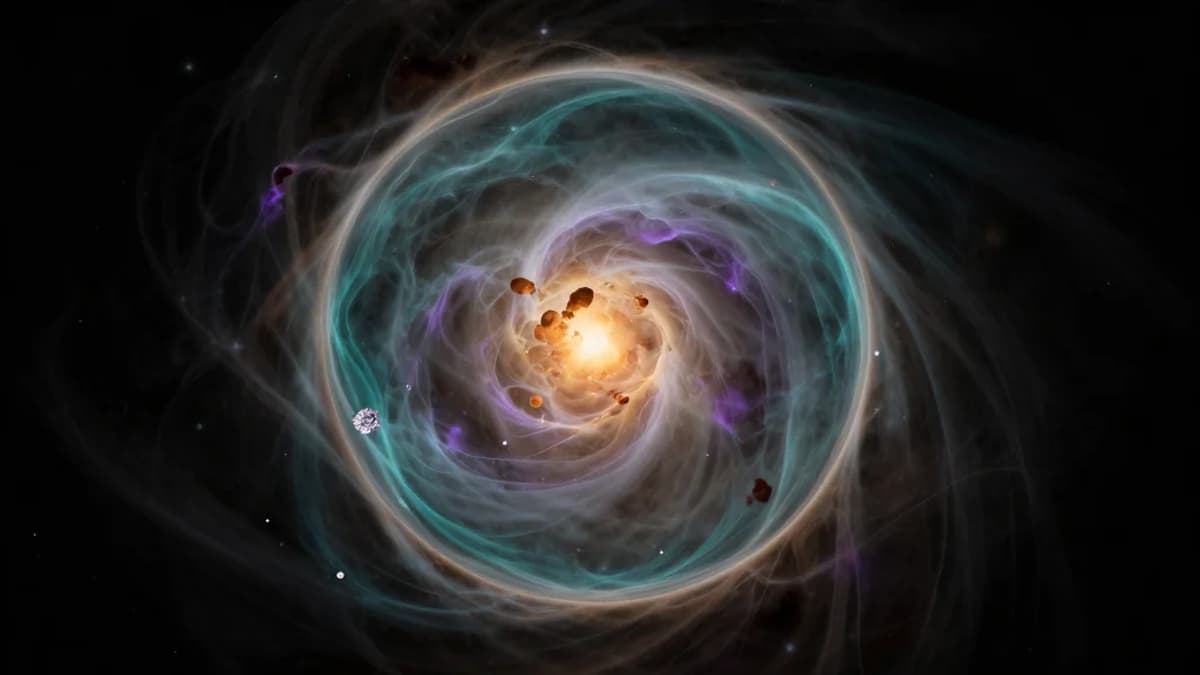
The Cranium Nebula’s appearance on the Astronomy Picture of the Day underscores the James Webb Space Telescope’s power to deliver high‑resolution, mid‑infrared views of distant stellar remnants. By capturing both mid‑ and near‑infrared wavelengths, Webb exposes structural details—such as the dark vertical division and thin outer shell—that are invisible to optical telescopes. This level of detail not only fuels public fascination but also provides researchers with a richer dataset for analyzing the composition and temperature gradients within the nebula.
At the heart of the scientific debate lies the nebula’s true progenitor. If it is a planetary nebula, the central white dwarf would have expelled its outer layers after exhausting nuclear fuel, offering a textbook case of low‑mass stellar death. Conversely, a Wolf‑Rayet star scenario implies a massive, rapidly rotating star shedding material through fierce stellar winds, a process that can seed the surrounding interstellar medium with heavy elements. Distinguishing between these pathways is critical for calibrating stellar evolution models, especially those that predict the timing and mechanics of supernova events.
Future Webb observations, potentially complemented by ground‑based spectroscopy, aim to monitor changes in the nebula’s brightness and spectral signatures. Detecting signs of an imminent supernova would have profound implications for understanding how massive stars enrich galaxies and trigger subsequent star formation. Moreover, the high‑profile nature of this discovery reinforces the telescope’s role in driving scientific funding and inspiring the next generation of astronomers, cementing its status as a cornerstone of modern astrophysical research.
Untitled
0
Comments
Want to join the conversation?
Loading comments...