Why It Matters
CG 4 offers a nearby laboratory for studying how massive star radiation and supernova shocks sculpt star‑forming clouds, informing models of stellar birth and interstellar dynamics.
Key Takeaways
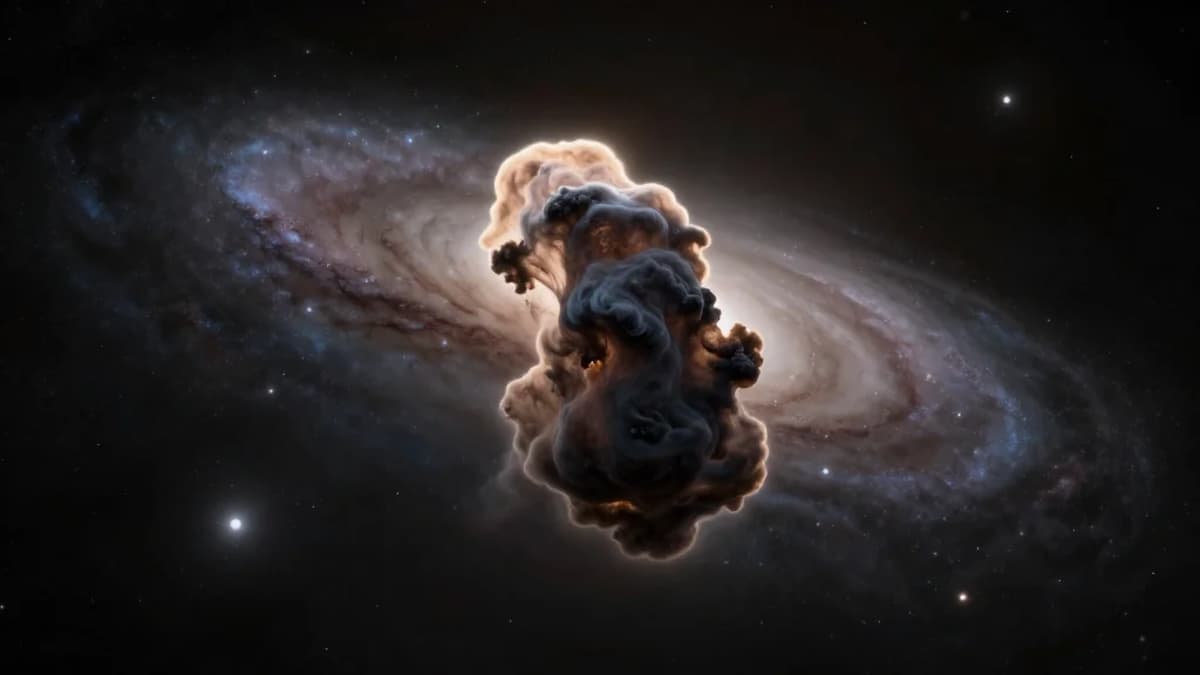
- •CG4 is a cometary globule 1,300 light‑years away
- •Head 1.5 ly, tail 8 ly long
- •Shaped by Vela supernova or massive star radiation
- •Points away from Vela remnant in Gum Nebula
- •Background galaxy ESO 257‑19 lies 100 Mly beyond
Pulse Analysis
Cometary globules like CG 4 are compact pockets of cold molecular gas where hydrogen atoms pair into H₂, creating the raw material for new stars. Their distinctive comet‑shaped silhouettes arise when intense ultraviolet radiation or shock fronts erode one side of a dense cloud, leaving a bright, illuminated head and a trailing tail. At 1,300 light‑years, CG 4 is close enough for high‑resolution imaging, allowing astronomers to map temperature gradients and density structures that precede star formation, a process that remains a cornerstone of galactic evolution studies.
The orientation of CG 4’s tail points directly away from the Vela Supernova Remnant, a massive explosion that occurred roughly 11,000 years ago and now powers the expansive Gum Nebula. This alignment suggests that the remnant’s shock wave or the intense radiation from nearby O‑type stars compressed the globule’s leading edge, carving its tail. Understanding such interactions helps refine simulations of how supernova feedback regulates the interstellar medium, either triggering or quenching subsequent star‑forming episodes across the Milky Way.
Beyond its scientific intrigue, CG 4’s inclusion in APOD highlights the public’s appetite for vivid cosmic imagery and the educational value of contextualizing astronomical phenomena. As telescopes like JWST and upcoming ground‑based observatories target similar structures, data from CG 4 will serve as a benchmark for interpreting more distant, less resolved globules. The juxtaposition of the nearby cloud with the distant galaxy ESO 257‑19 also underscores the layered complexity of the universe, reminding both researchers and enthusiasts that even seemingly isolated objects are part of a vast, interconnected cosmos.
Untitled
0
Comments
Want to join the conversation?
Loading comments...