Why It Matters
The picture reinforces the Atacama Desert’s status as a premier site for deep‑sky observation and fuels public fascination with space, supporting both scientific research and astronomy outreach.
Key Takeaways
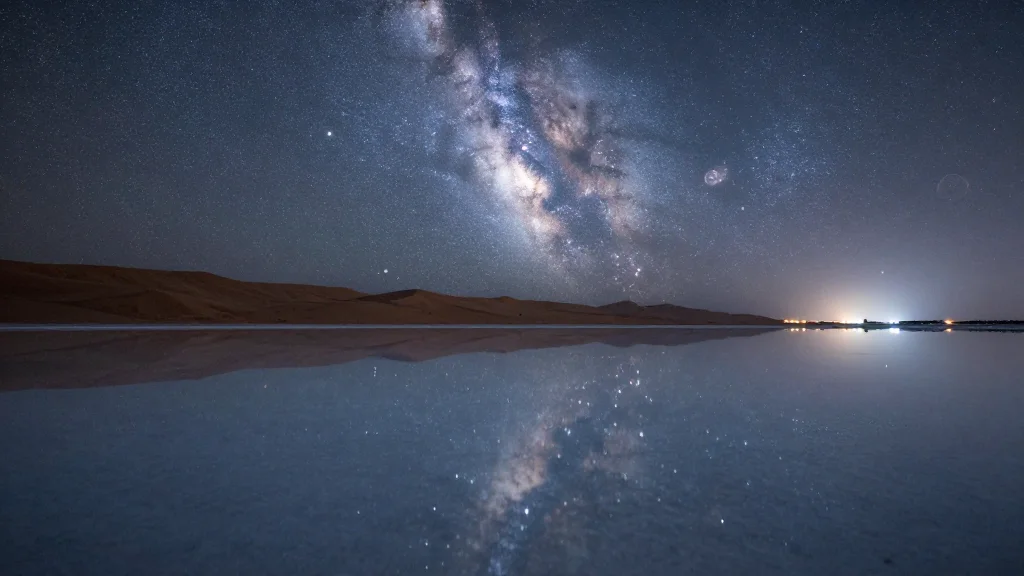
- •27‑frame mosaic captured in Atacama Desert, 2019
- •Lagoon reflects Milky Way, appearing as an eye
- •Jupiter and Saturn visible alongside galactic band
- •Image underscores Atacama’s value for astrophotography
- •APOD promotes public engagement with astronomy
Pulse Analysis
The Astronomy Picture of the Day (APOD) continues to serve as a daily portal into the cosmos, and the April 19 2026 entry is a striking example. Photographed in 2019, the 27‑frame mosaic from Ojas de Salar in Chile’s Atacama Desert captures a tranquil lagoon that mirrors the Milky Way, creating an eye‑like illusion. The composition also includes the bright discs of Jupiter and Saturn, offering a rare glimpse of planetary alignment against the galactic backdrop. Such high‑resolution composites demonstrate how modern imaging techniques can transform remote, stark landscapes into compelling visual narratives.
Atacama’s extreme altitude, minimal cloud cover, and negligible light pollution make it one of the world’s most coveted locations for professional and amateur astronomers alike. The region hosts major observatories such as the Very Large Telescope and the upcoming Extremely Large Telescope, leveraging the same clear skies that produced the APOD image. The desert’s unique geology—dry, flat, and mineral‑rich—provides stable platforms for telescopes and reduces atmospheric distortion, enabling deeper and sharper views of distant celestial objects. This environment also supports innovative projects like high‑speed adaptive optics and interferometry, pushing the boundaries of what can be observed from Earth.
Beyond scientific merit, images like this drive public engagement and inspire tourism. Travelers seeking astrophotography experiences flock to the Atacama, contributing to local economies while fostering a broader appreciation for space science. Educational programs often use APOD visuals to illustrate concepts ranging from planetary motion to galactic structure, making complex astronomy accessible to students and enthusiasts. As interest in space exploration grows, such compelling imagery will remain a vital bridge between cutting‑edge research and the general public, reinforcing the cultural relevance of astronomy in a technology‑driven world.
Untitled
Comments
Want to join the conversation?
Loading comments...