Companies Mentioned

NASA
Why It Matters
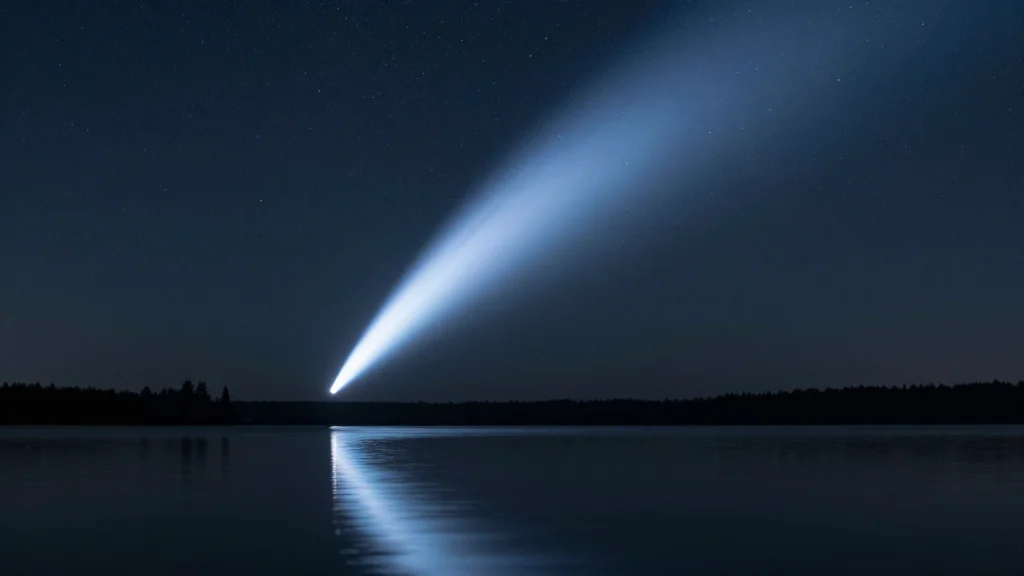
The image illustrates the growing interference of megaconstellations with astronomical research, threatening data quality and discovery potential. It also highlights a narrow window to study a bright new comet before it fades into interstellar space.
Key Takeaways
- •Comet C/2025 R3 (PanSTARRS) appears behind dense satellite trails
- •Image captured in Bavaria, Germany, just before sunrise
- •Comet will be best observed from southern‑hemisphere skies in weeks
- •As it recedes, the comet will fade into interstellar space
- •Satellite streaks result from 10‑minute long‑exposure photography
Pulse Analysis
Comet C/2025 R3 (PanSTARRS) was discovered by the Pan-STARRS survey in late 2025 and quickly attracted attention for its bright nucleus and long ion tail. Orbit calculations show the comet will swing close to the Sun before being flung onto an outbound trajectory that will carry it beyond the heliosphere. For astronomers, such near‑Sun passages provide rare opportunities to study cometary composition, outgassing behavior, and solar wind interactions, making timely observations critical before the object fades.
The APOD photograph highlights a growing concern for the scientific community: the proliferation of low‑Earth‑orbit satellite constellations. Long‑exposure astrophotography, essential for capturing faint objects like comets, now routinely records streaks that can obscure or contaminate data. Researchers are developing mitigation strategies, from software algorithms that remove streaks to coordinated scheduling that avoids peak satellite density periods. The visual of comet R3 tangled in trails serves as a vivid reminder that space traffic management will increasingly intersect with observational astronomy.
Looking ahead, comet R3 will become more accessible to observers in the Southern Hemisphere as it moves away from solar glare. Amateur and professional astronomers alike are encouraged to target the comet during its optimal window, which will last several weeks before it drifts into interstellar space and dims beyond detection. This fleeting visibility underscores the need for rapid data collection and collaborative networks that can share observations across latitudes. As satellite traffic continues to rise, the astronomy community may also push for regulatory frameworks that balance commercial satellite deployment with the preservation of dark skies for scientific discovery.
Untitled
Comments
Want to join the conversation?
Loading comments...