Why It Matters
A bright, near‑Earth comet provides a high‑profile outreach moment and a chance to study cometary composition and fragmentation in real time.
Key Takeaways
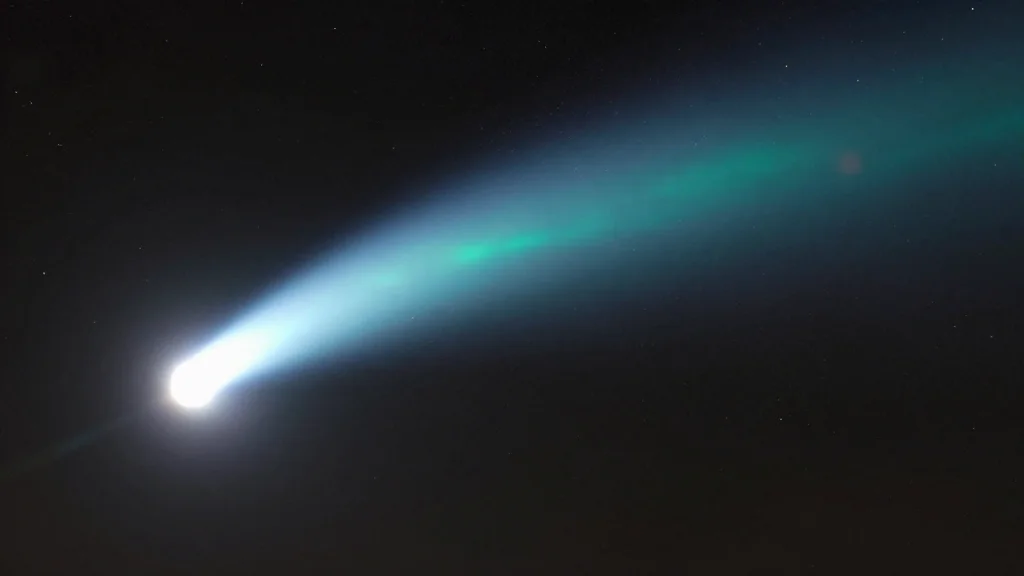
- •Comet C/2025 R3 (PanSTARRS) brightening rapidly in April 2026.
- •Perihelion on April 19; closest Earth approach on April 25.
- •Tail now spans over 10 degrees across the sky.
- •Potential naked‑eye visibility within a week if brightness holds.
- •Risk of disintegration near Sun similar to recent comet A1 (MAPS).
Pulse Analysis
Comet C/2025 R3 (PanSTARRS) was first spotted in late 2025 and has been inching brighter each month. Its elliptical orbit brings it within 0.3 AU of the Sun on April 19, 2026, a perihelion distance that places it among the most sun‑grazing comets of the decade. The geometry of its trajectory also aligns it to pass within roughly 0.07 AU of Earth on April 25, creating a narrow window for optimal viewing from mid‑latitudes in the Northern Hemisphere.
For amateur astronomers, the comet’s current 10‑degree tail—visible from dark sites before sunrise—offers a spectacular sky‑watching target. Observers in Europe and North America can expect the comet to rise a few hours before dawn, with its magnitude potentially reaching the naked‑eye threshold of +6 by the end of the week. Light‑polluted urban areas may still require binoculars or a modest telescope, but the elongated ion tail will be evident even in modest equipment, making it a prime “camera comet” for social‑media sharing and outreach programs.
Scientifically, R3 presents a live laboratory for studying volatile release and nucleus stability under intense solar heating. Past comets like A1 (MAPS) have fragmented near perihelion, and R3 could follow a similar fate, offering clues about the internal structure of “dirty ice” bodies. Spectroscopic observations during its close approach could reveal water‑ice, carbon‑based compounds, and dust grain properties, informing models of comet evolution and the early solar system. Whether it survives or disintegrates, R3 will enrich both public enthusiasm and academic research.
Untitled
Comments
Want to join the conversation?
Loading comments...