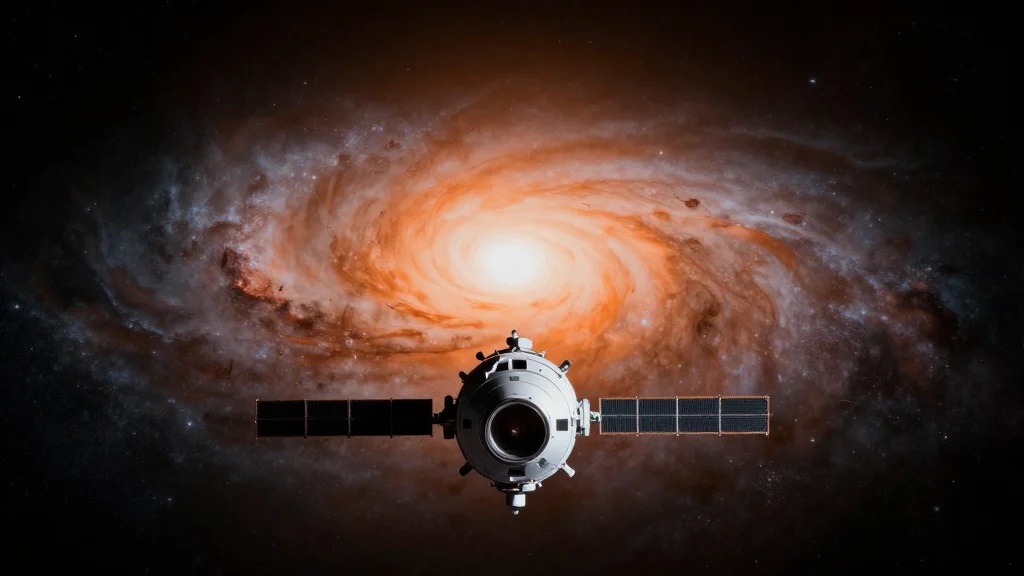
Upcoming Telescopes Could Shed Light on Dark Matter
Why It Matters
Confirming a dark‑matter signal would close a half‑century gap in fundamental physics and reshape cosmological models, while guiding future particle‑physics experiments.
Key Takeaways
- •Fermi-LAT detected unexplained gamma‑ray excess at Milky Way center
- •Dwarf galaxy studies reveal growing gamma‑ray signal consistent with dark matter
- •Rubin Observatory will expand dwarf galaxy catalog for indirect dark‑matter searches
- •COSI launch 2027 aims to map positron annihilation sky, aiding dark‑matter clues
Pulse Analysis
The mystery of dark matter—an invisible substance accounting for roughly 85% of the universe’s mass—has driven astrophysics toward indirect detection methods. By tracking high‑energy gamma rays produced when hypothetical dark‑matter particles annihilate, researchers can infer the presence of these particles without ever seeing them directly. This approach mirrors medical PET scans, where annihilation photons reveal hidden structures, and it provides a unique window into the particle physics that underpins cosmic evolution.
Recent work with NASA’s Fermi Large Area Telescope has sharpened this window. A persistent gamma‑ray glow at the Milky Way’s center, long debated as either dark‑matter‑related or a by‑product of dense neutron‑star populations, now mirrors a faint excess observed across dozens of dwarf galaxies orbiting our own. These diminutive systems, largely free of competing astrophysical sources, amplify the statistical weight of the signal, nudging it toward significance while still falling short of a definitive discovery. The convergence of two independent sky regions strengthens the case that we may be witnessing the first fingerprints of dark‑matter annihilation.
Looking ahead, the Vera C. Rubin Observatory will dramatically increase the known dwarf‑galaxy census, supplying fresh targets for gamma‑ray scrutiny. Complementing this, the Compton Spectrometer and Imager (COSI), slated for launch in 2027, will map the sky’s positron‑annihilation glow with unprecedented clarity, potentially disentangling dark‑matter signatures from conventional astrophysical processes. Together, these next‑generation instruments could resolve a fundamental question in physics, guiding both cosmological theory and the design of future particle detectors on Earth and in space.
Upcoming telescopes could shed light on dark matter
Comments
Want to join the conversation?
Loading comments...