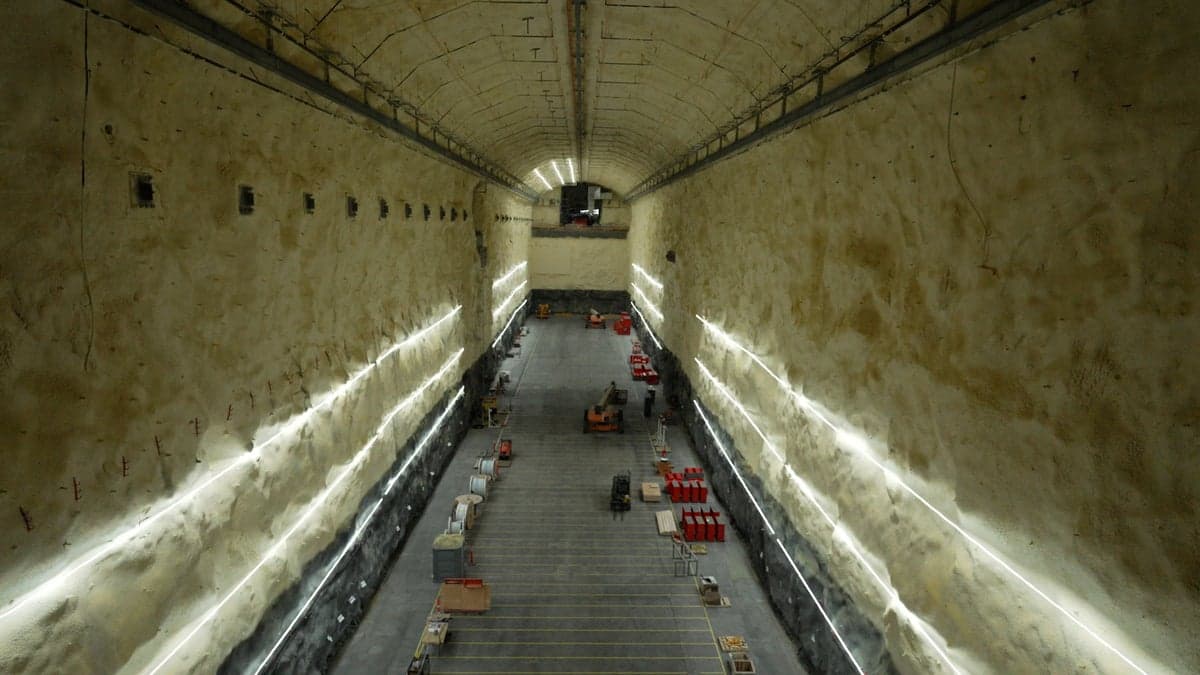
U.S. Neutrino Megaproject Takes Shape in Abandoned Gold Mine
Why It Matters
The experiment could resolve fundamental questions about why the universe contains more matter than antimatter, shaping the future of particle physics. Its success also secures U.S. leadership in a high‑stakes, multi‑billion‑dollar scientific arena.
Key Takeaways
- •DUNE begins underground steel beam installation at Sanford Lab.
- •First 10 million‑pound (≈$12.7 M) steel container to be completed in nine months.
- •Project budget nears $5 billion, delayed five years, first detector targeted for 2030.
- •DUNE will use the most intense neutrino beam and largest liquid‑argon detectors.
- •Competing Hyper‑K (2028) and China’s JUNO aim to answer neutrino ordering sooner.
Pulse Analysis
The Deep Underground Neutrino Experiment represents the most ambitious U.S. particle‑physics undertaking since the Large Hadron Collider, marrying a $5 billion budget with a mile‑deep underground laboratory. By directing the world’s most powerful neutrino beam from Fermilab to a cavern filled with tens of millions of pounds of liquid argon, DUNE seeks to measure neutrino oscillations over an 800‑mile baseline. These measurements could finally determine the neutrino mass hierarchy and test whether CP‑violation in the lepton sector explains the matter‑antimatter imbalance that gave rise to galaxies, stars, and life.
The project’s engineering hurdles are equally formidable. The first steel container, weighing 10 million pounds (about $12.7 million), is being lowered through a 20‑foot shaft—a logistical feat likened to building a ship inside a bottle. Once underground, thousands of hand‑strung wire planes will be installed to capture the faint ionization signals produced when a neutrino interacts with liquid argon. Delays have already added five years to the schedule, pushing the initial data‑taking window to 2030, while the total cost approaches $5 billion, prompting close scrutiny from Congress.
Success will cement U.S. leadership in a field where Japan’s Hyper‑K and China’s JUNO are racing to deliver early results on the same questions. Even if DUNE’s answers arrive later, its unprecedented detector size and beam intensity will provide a platform for a generation of follow‑up experiments, from dark‑matter searches to proton‑decay investigations. Moreover, the massive cryogenic and underground‑construction expertise being cultivated can spill over into commercial sectors such as deep‑earth mining, high‑capacity refrigeration, and large‑scale data acquisition, amplifying the project’s broader economic impact.
U.S. neutrino megaproject takes shape in abandoned gold mine
Comments
Want to join the conversation?
Loading comments...