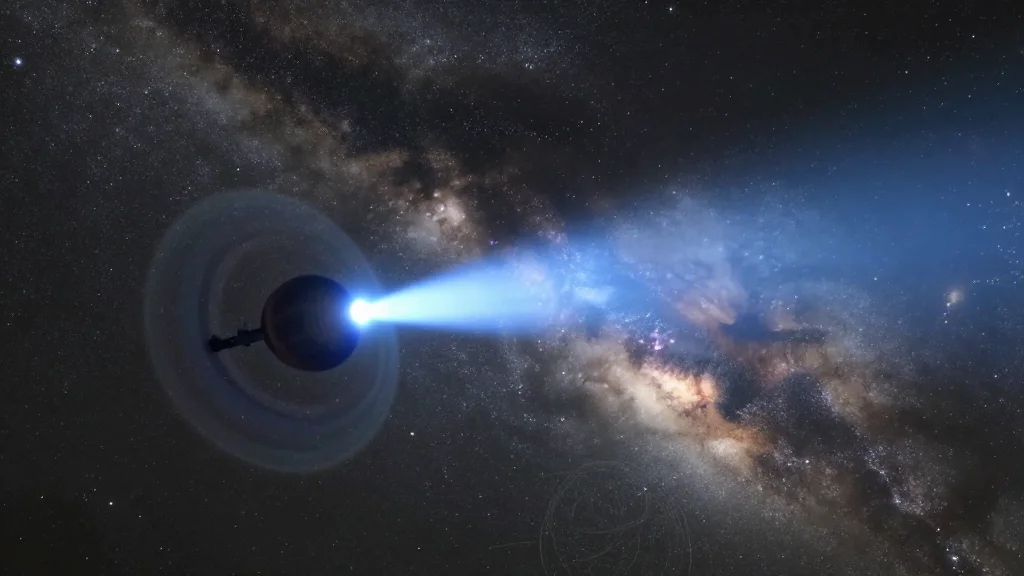
Using Pulsars as Ultra-Precise Gravitational Probes to 'Weigh' Neighboring Galaxies
Why It Matters
Direct acceleration measurements provide a cleaner probe of dwarf‑galaxy mass, sharpening our view of dark‑matter distribution and the Milky Way’s evolutionary history.
Key Takeaways
- •Pulsar timing detects minute galactic accelerations from dwarf galaxies.
- •Method yields LMC mass ~41 billion solar masses.
- •Sagittarius dwarf estimated at ~350 million solar masses.
- •Accelerations avoid assumptions required by traditional stellar kinematics.
- •Larger pulsar sample improves sensitivity to dark‑matter sub‑halos.
Pulse Analysis
Pulsars, the universe’s most reliable clocks, emit radio pulses with sub‑microsecond regularity. When a massive object such as a dwarf galaxy perturbs the Milky Way’s gravitational field, the resulting acceleration subtly shifts the arrival times of these pulses. By monitoring a network of millisecond pulsars spread across the sky, astronomers can translate timing residuals into a map of local acceleration, turning each pulsar into a miniature gravitational antenna. This technique, long used for detecting gravitational waves, now extends to measuring the steady‑state pull of nearby satellite galaxies.
The UAH team leveraged an expanded catalog of 54 pulsars to isolate the acceleration signatures of the Large Magellanic Cloud and the Sagittarius dwarf spheroidal galaxy. Their models, calibrated against high‑resolution simulations, produced mass estimates of ~41 billion M☉ for the LMC and ~350 million M☉ for Sagittarius—figures that align with, yet refine, previous kinematic studies. Unlike star‑motion methods that must assume equilibrium and disentangle overlapping dynamical processes, pulsar‑based acceleration directly probes the gravitational potential, reducing systematic uncertainties. The result is a more precise accounting of both baryonic and dark matter components in these satellites.
Beyond weighing individual dwarfs, the approach opens a pathway to charting the Milky Way’s dark‑matter sub‑halo population. As pulsar timing arrays grow and timing precision improves, astronomers anticipate detecting even fainter accelerations from smaller, dark‑matter‑dominated clumps. Mapping these sub‑halos will test competing dark‑matter theories and inform models of galaxy formation. In the broader cosmological context, pulsar acceleration measurements could become a standard tool for probing mass distributions in the local universe, complementing lensing and stellar‑kinematic techniques and sharpening our overall picture of cosmic structure.
Using pulsars as ultra-precise gravitational probes to 'weigh' neighboring galaxies
Comments
Want to join the conversation?
Loading comments...