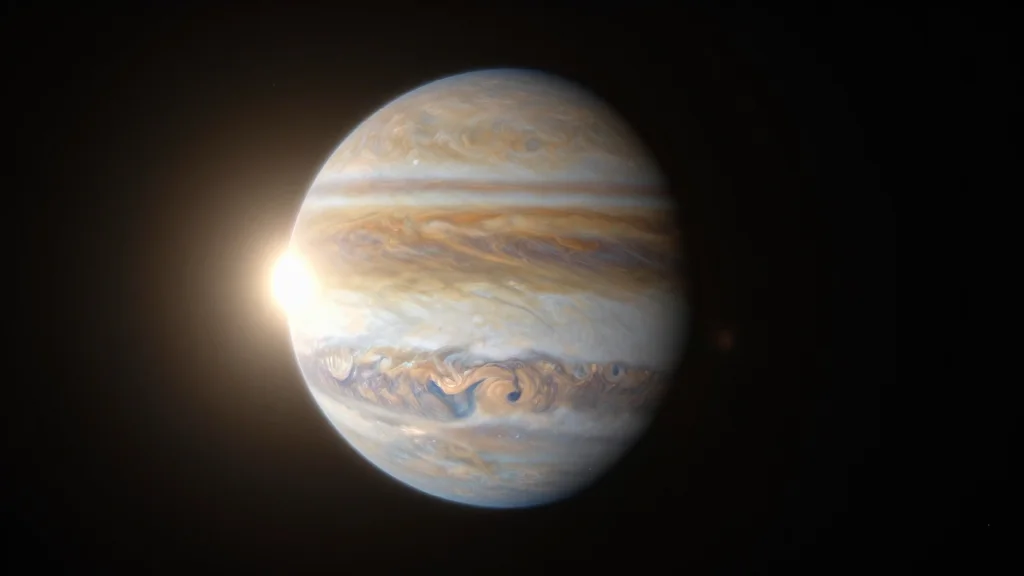
Using Webb Astronomers Think They Have Detected Daily Weather Changes on Exoplanet
Why It Matters
Detecting diurnal weather on an exoplanet showcases JWST’s power to probe atmospheric dynamics, opening a new window on climate processes beyond the solar system.
Key Takeaways
- •JWST infrared spectra reveal morning magnesium‑silicate clouds on WASP‑94A b
- •Evening side appears clear, suggesting rapid atmospheric changes
- •Possible explanations: strong winds or daytime cloud dissipation
- •Planet orbits its star every four days, half Jupiter’s mass
- •Results remain uncertain due to limited distant observations
Pulse Analysis
The James Webb Space Telescope has transformed exoplanet science by delivering high‑resolution infrared spectra that can dissect distant atmospheres. Prior to JWST, most atmospheric detections were limited to bulk compositions or static cloud decks. By capturing the thermal emission of WASP‑94A b at different orbital phases, astronomers can now infer how temperature and chemistry evolve over a single planetary day, a capability that was previously only imagined for nearby solar‑system worlds.
WASP‑94A b is a classic hot‑Jupiter, skimming its host star every four days and reaching temperatures hot enough to vaporize rock‑forming minerals. The new data show a pronounced morning haze of magnesium‑silicate particles—essentially a mineral cloud—while the evening hemisphere appears largely clear. This stark contrast suggests either powerful east‑west winds that sweep clouds away before nightfall, or a rapid condensation‑evaporation cycle akin to Earth’s fog that dissipates as the planet’s surface heats. Either scenario points to atmospheric dynamics far more complex than the simple, static models that dominated early exoplanet studies.
If confirmed, these diurnal variations will reshape how scientists model climate on tidally locked giants and inform the search for habitability on smaller, rocky worlds. The detection also highlights the challenges of interpreting limited snapshots from 700 light‑years away, underscoring the need for multi‑epoch observations and complementary instruments. As JWST continues to monitor a growing roster of exoplanets, the field moves closer to building a comparative planetary meteorology, where weather patterns become a diagnostic tool for composition, circulation, and even potential biosignatures. The next wave of data promises to refine these early hints into a robust framework for exoplanet climate science.
Using Webb astronomers think they have detected daily weather changes on exoplanet
Comments
Want to join the conversation?
Loading comments...