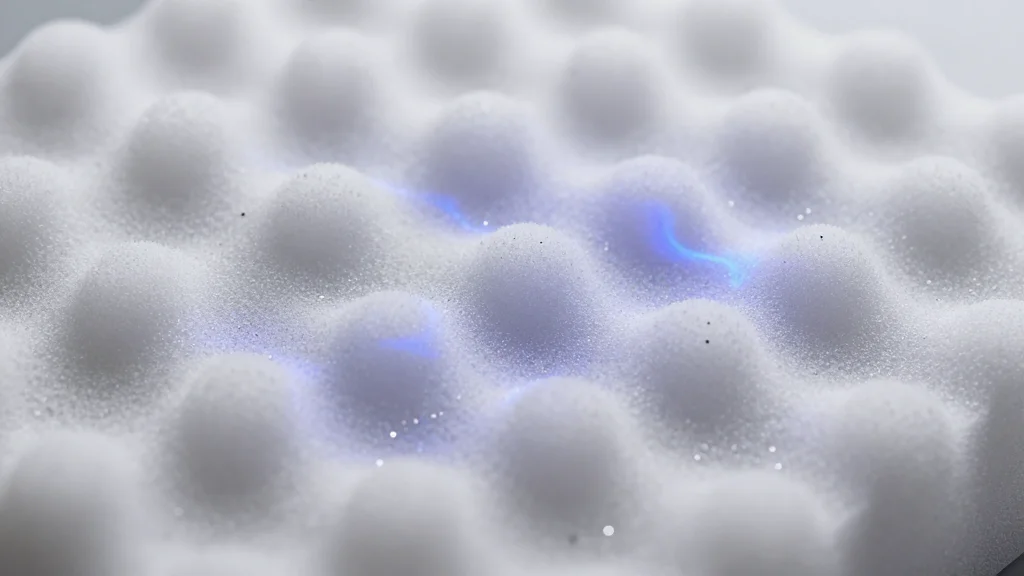
Vapor Phase Infiltration Modulating Microwave Absorption of Conductive Polymers: Frequency Tunability and Polarization Enhancement
Why It Matters
The technique unlocks customizable, high‑efficiency microwave shielding for wearable and aerospace applications, addressing the industry’s need for lightweight, adaptable EM protection.
Key Takeaways
- •VPI introduces Ti-based nano-domains into PEDOT:PSS foams.
- •Ti infiltration boosts permittivity and polarization loss for stronger absorption.
- •Adjusting VPI cycles shifts absorption peak to lower frequencies.
- •Deeper Ti diffusion enhances organic‑inorganic interfacial coupling.
- •Tunable dielectric response enables lightweight, flexible EM wave shields.
Pulse Analysis
Vapor phase infiltration (VPI) is emerging as a precise tool for engineering the electromagnetic properties of conductive polymers. By delivering TiCl4 vapor into PEDOT:PSS‑coated foams, researchers create nanoscale Ti‑rich hybrid domains that act as polarizable centers. This inorganic infusion not only raises the material’s permittivity but also activates polarization‑dominated dielectric loss mechanisms that are otherwise dormant in pure polymer matrices. The ability to control infiltration depth and cycle count translates directly into a tunable dielectric constant, allowing designers to shift absorption peaks across the microwave spectrum without altering the bulk geometry.
The significance of this development extends beyond laboratory curiosity. Traditional microwave absorbers rely on bulky metal composites or fixed‑property ceramics, which add weight and limit form‑factor flexibility. The VPI‑enhanced PEDOT:PSS foams maintain the polymer’s inherent lightness and mechanical compliance while delivering absorption levels comparable to heavier alternatives. This opens pathways for integrating EM shielding into wearable sensors, flexible antennas, and aerospace panels where every gram counts. Moreover, the process is compatible with roll‑to‑roll manufacturing, suggesting a viable route to large‑scale production.
From a market perspective, the demand for adaptable electromagnetic interference (EMI) solutions is accelerating, driven by the proliferation of 5G, IoT devices, and electric vehicles. Materials that combine tunable dielectric response with structural flexibility can reduce design cycles and inventory complexity for OEMs. VPI’s controllable chemistry also enables tailoring of absorption characteristics for specific frequency bands, offering a competitive edge in niche applications such as stealth technology or medical imaging equipment. As industries seek lighter, smarter shielding, VPI‑modified conductive polymers are poised to become a cornerstone of next‑generation EM protection strategies.
Vapor Phase Infiltration Modulating Microwave Absorption of Conductive Polymers: Frequency Tunability and Polarization Enhancement
Comments
Want to join the conversation?
Loading comments...