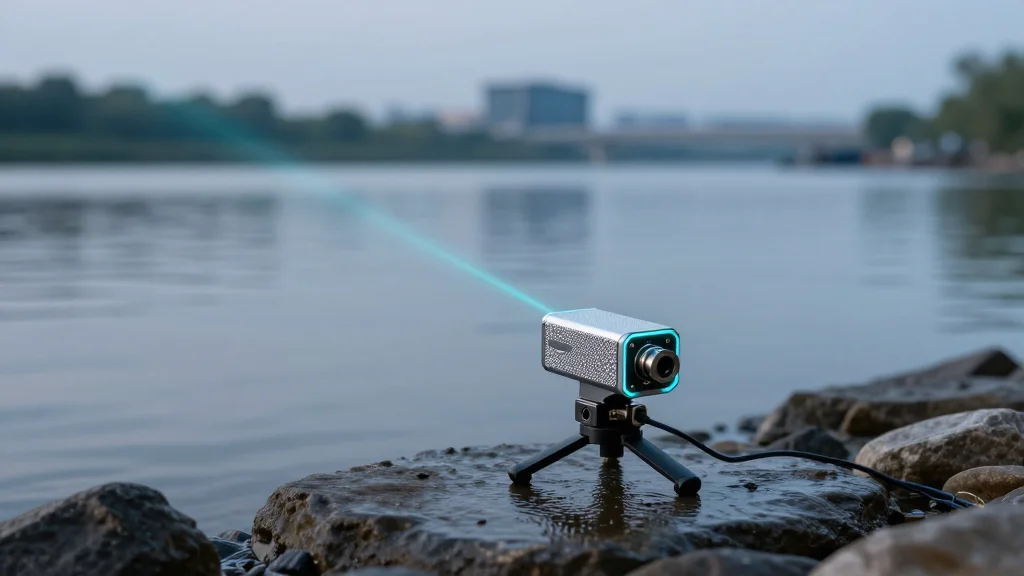
Vector Photonics Demos Free-Space Optical Communication Using PCSEL Outside of a Lab
Why It Matters
The demonstration validates PCSELs as a viable alternative to fiber and radio for high‑speed, secure links, opening new revenue streams in campus, satellite and data‑center markets.
Key Takeaways
- •First public PCSEL free-space link demonstrated outside lab.
- •50 Mbps data transferred over 500 m with low error rates.
- •TRL advanced from 4/5 to 6/7, indicating commercial readiness.
- •PCSELs provide narrow beams, high power, and wavelength flexibility.
- •Supports secure, cable‑free connectivity for campuses, satellites, AI data centers.
Pulse Analysis
Free‑space optical communication (FSO) has long promised ultra‑high bandwidth links without the cost of laying fiber, yet atmospheric turbulence and alignment challenges have kept it niche. Photonic crystal surface‑emitting lasers (PCSEL) address these hurdles by delivering a high‑power, single‑mode beam directly from a planar surface, reducing divergence and simplifying optics. Their ability to operate across a broad spectral range—from ultraviolet to far‑infrared—means they can be tuned for optimal atmospheric windows, enhancing reliability in rain, fog, or temperature swings.
The River Clyde trial marks a watershed moment for the technology. By partnering with Fraunhofer’s Centre for Applied Photonics, Vector Photonics moved PCSELs from a laboratory TRL of 4‑5 to a near‑commercial 6‑7, demonstrating 50 Mbps throughput over half a kilometre with error rates well below forward‑error‑correction thresholds. This performance exceeds the experiment’s specifications and showcases the lasers’ capacity for even higher data rates, positioning them as a compelling backhaul solution for dense urban campuses, secure inter‑building links, and low‑latency satellite ground stations.
Looking ahead, PCSELs could become a cornerstone of next‑generation networks that blend fiber, 5G, and satellite components. Their compact form factor and low‑divergence output are ideal for integrating into AI‑driven data‑center interconnects, LiDAR platforms, and additive‑manufacturing monitoring systems. As telecom operators and cloud providers seek to diversify bandwidth sources, investment in PCSEL‑based FSO systems is likely to accelerate, potentially reshaping the economics of high‑speed connectivity and reducing reliance on traditional radio spectrum.
Vector Photonics demos free-space optical communication using PCSEL outside of a lab
Comments
Want to join the conversation?
Loading comments...